Dynamic initialization states that we are initializing the objects at the runtime. Since we use constructors to initialize everything, here we are going to use dynamic constructors.
Here is an example of dynamic initialization:
#include<iostream>

using namespace std;

class Details {
    string name;
    int age;
    int rollno;

    public:
    Details(string n,int a,int r) {
        name=n;
        age=a;
        rollno=r;
    }

    void disp() {
        cout<<"The name of the Student is: " <<name<<"\n";
        cout<<"The age of the Student is: " <<age<<"\n";
        cout<<"The rollno of the Student is: " <<rollno<<"\n";
    }
};

int main() {
    string n;
    int a,r;

    cout<<"Please enter the name of the Student --> ";
    cin>>n;

    cout<<"Please enter the age of the Student --> ";
    cin>>a;

    cout<<"Please enter the rollno of the Student --> ";
    cin>>r;

    //Dynamically initializing
    Details firststudent(n,a,r);
    firststudent.disp();

    return 0;
}
Output:
Please enter the name of the Student --> neeraj
Please enter the age of the Student --> 28
Please enter the rollno of the Student --> 121
The name of the Student is: neeraj
The age of the Student is: 28
The rollno of the Student is: 121
This dynamic initialization can help us to create different constructors having the same function name but different parameters.
If you want to deallocate the memory then the delete operator can be used.
I hope you have understood this blog. Please do comment below if you are still facing any difficulties with the dynamic initialization of objects.
Anders Hejlsberg is quite a famous personality, being a Technical Fellow in the Developer Division of Microsoft, Hejlsberg is popularly known as the influential creator of the development tools and various programming languages. He’s a chief designer of C# programming language as well as a key participant in the development of the Microsoft .NET Framework. Since its release in 2000, the C# programming language has actually gained huge adoption and now is standardized by ISO and ECMA.
Anders Hejlsberg is a popular Danish programming engineer born on 2nd December 1960. He designed many popular and successful programming languages as well as development tools. Andres was an original author of the Turbo Pascal and key architect of Delphi. Currently, he is working for Microsoft company as a lead architect of C# & core developer at TypeScript.
Before connecting with Microsoft in 1996, Hejlsberg was an employee of Borland International Inc. Being a principal engineer, Turbo Pascal was originally written by Andres Hejlsberg, an integrated development, and architect of the successor, Delphi.
Early & Career Life
Andres studied engineering at Denmark’s Technical University but didn’t graduate. Though in 1980, he started writing various programs for the Nascom microcomputer, which includes the Pascal compiler that was marketed as a Blue Label Software for Nascom-2. But, soon he rewrote this for DOS and CP/M, marketing it as Compas Pascal & then as PolyPascal.
After that, this product was given license at Borland, and then integrated into IDE which became the Turbo Pascal system. PolyPascal was in competition with Turbo Pascal. The compiler was highly inspired by “Tiny Pascal” compiler “Algorithms and Data Structures = Programs by in Niklaus Wirth”, an influential computer book of that time.
Andres Hejlsberg with his partners ran the computer store that was located in Copenhagen & marketed accounting systems. The company, PolyData, was a key distributor for various Microsoft products of Denmark that put it at Borland. Hejlsberg and Philippe Kahn met first in 1986. For those initial years, Jensen Niels, who was Borland’s founder and majority shareholder, had handled this relationship between Borland & PolyData successfully.
Life at Borland
In hands of Borland, Turbo Pascal became a huge hit commercially as a Pascal compiler ever. Andres Hejlsberg stayed with PolyData till his company came under financial stress, during that time, he shifted to California and there he became the Chief Engineer in Borland. There he stayed until 1996. At this time he went ahead and developed Turbo Pascal, and became a lead architect for his team that produced a replacement for the Turbo Pascal, Delphi.
Life at Microsoft
Andres left Borland in 1996 to join archrival Microsoft. His achievements were J++ programming language & Windows Foundation Classes; soon he became the Microsoft Distinguished Engineer & Technical Fellow. Since 2000, Andres was the chief architect of his team developing the C# programming language.
We can pass objects as arguments in member or non member functions. They can be passed either by value or reference. Pass by value creates another copy of the particular object which is deleted after the function is ended. Pass by reference means that we are passing the same object as a reference so if we do any changes in the object then it will remain permanently.
Here is an example of passing objects in function arguments.
#include<iostream>

using namespace std;

class student{
    string name;
    double marks;

    public:
    void details(){
        cout<<"Enter the name of the student ";
        cin>>name;
        cout<<"Enter the marks scored by the student out of 100: ";
        cin>>marks;
    }

    void printdetails(){
        cout<<"The name of the student is: "<<name;
        cout<<"The marks scored by the student is: "<<marks;
    }

    // Passing two objects s1 and s2 of the student class.
    void avgmarks(student s1,student s2){
        cout<<"The avg marks scored is: "<<(s1.marks+s2.marks)/2<<"\n";
    }
};

int main(){
    student s1,s2,s3;

    cout<<"Details of 1st student"<<"\n";
    s1.details();

    cout<<"Details of 2nd student"<<"\n";
    s2.details();

    s3.avgmarks(s1,s2);
}
Output:
Details of 1st student
Enter the name of the student Pulkit
Enter the marks scored by the student out of 100: 88.9
Details of 2nd student
Enter the name of the student Rahul
Enter the marks scored by the student out of 100: 75.4
The avg marks scored is: 82.15
In the above code, we are passing the objects in the avgmarks() function, using the information provided by both the objects the average mark is calculated.
I hope you have understood this blog. Please do comment below if you are still facing any difficulties with this topic.
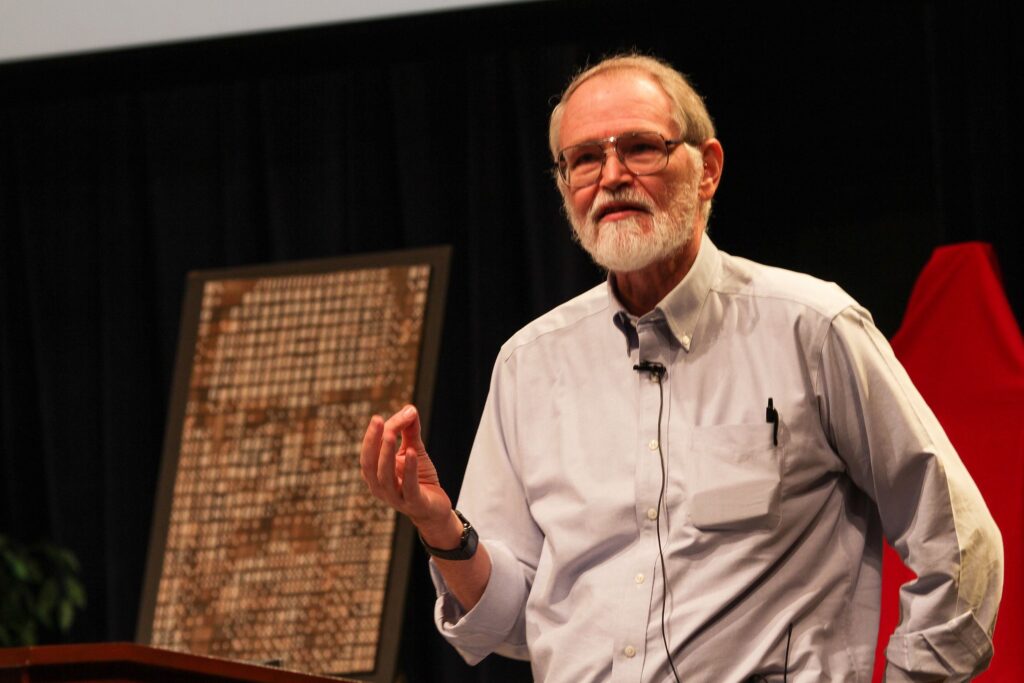
Brian Wilson Kernighan is a computer scientist from Canada. He worked at Nokia Bell labs. This is an American industrial research and scientific development company owned by a multinational company Nokia. He contributed to the development of UNIX with Ken Thomson and Dennis Ritchie. Brian Kernighan worked as co-author with Dennis Ritchie on the book The C Programming Language. Brian became famous through this C programming book.
Brian wrote many programs for Unix, including ditroff. Brian Kernighan is also coauthor of AWK which is a domain-specific language and AMPL which is a mathematical programming language. The K in AWK stands for “Kernighan”. Brian Kernighan formulated the famous heuristics for two NP-complete optimization problems: graph partitioning and traveling salesman problem with the help of Shen Lin. Later it was known as Lin-Kernighan heuristic.
Brian Kernighan currently working as a professor of computer science at Princeton University since 2000 and director of undergraduate studies in the department of computer science. Brian coauthored the book on the GO programming language in the year 2015.
Early Life
Brian was born on 1 January 1942 in Toronto. Brian enrolled in the university of Toronto from 1960 to 1964 and earned his engineering physics bachelor’s degree. In 1969 Brian received his Ph.D. from Princeton University in electrical engineering. He got his Ph.D. under the supervision of Peter G. Weiner by finishing a doctoral dissertation named “Some graph partitioning problems related to program segmentation”.
Career and Research
Brian Kernighan has served as a professor at Princeton University in the department of computer science from the year 2000. Every autumn Brian explains and teaches “Computers in our world,” course. It introduces the basic of computing to non-majors. Brian was the software editor of an American major educational publisher Prentice Hall International. Brian’s “software tools” series spread the basis of “C/Unix thinking” makeovers for BASIC, Pascal, Fortran and in particular, his Rational Fortran was placed in the public domain.
Brian Kernighan once said if abandoned on any island with one language it would be C language. Brian invented the term “Unix” and also helped to popularize Thomson’s Unix philosophy. Brian is known as the inventor of the term “What you see is all you get” (WYSIAYG), a satirical form of original term “What you see is what you get” (WYSIWYG).
In the year 1972, Brian Kernighan explained memory management in strings with the help of “hello” and “world”, in B language. It became an iconic example of the present time. Brian taught CS50 in 1996, It was the introductory course of computer science at Harvard University. In 2002, he was elected as a member of the National academy of engineering, and in 2019 elected a member of the American academy of arts and sciences.
Some Achievements
Developed AMPL programming language which is an algebraic modeling language.
Developed AWK programming language which is a domain specific language.
Developed ditroff which allowed troff to be used with any device.
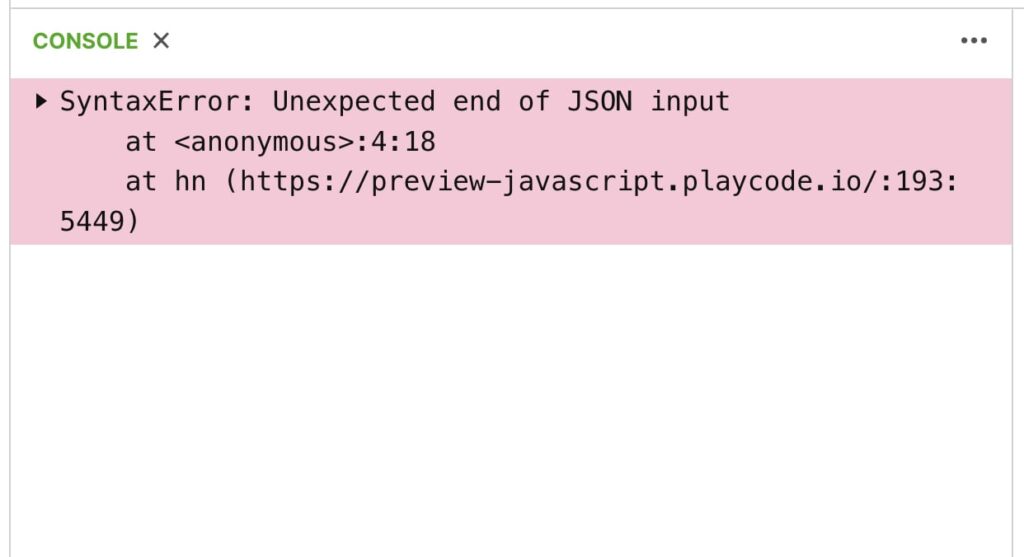
We all have tried fetching the data from the server by hitting an API and parsing the response to show it on the website. Chances are, you might have got this error at some point, and this is a common error to get stuck.
If you run the following code you will get this error.
I got this error and tried resolving it. Gone through the answers on Stackoverflow and tried debugging the code, and while debugging it, I figured out why this occurs and how you can avoid this error.
This error is because we might be trying to parse an empty string or an empty array using JSON.parse()
And since we are trying to parse an empty string or empty array, end of string is reached before parsing the content of JSON text.
We have to make sure that the JSON we are trying to parse is valid. We might be getting either an empty array or an empty string as the response.
Another reason might be due to the Content-type header. The value of the Content-type header must be application/json.
Even if the server might be sending an empty response, we should be checking that as well.
How to Solve Error?
The easiest way to fix this error is to wrap our code inside a try/catch block which will help us in catching the error and with the help of that, we can show some error message.
There is a good reason why computer science is a popular field of study all across the world. There is always a demand for computer scientists who can think outside the box and come up with new and better methods to use technology. There are currently computer science programs at nearly every university in Canada. There is, however, the challenge of deciding which colleges have the best programs to choose from. We’ve compiled a list of Canada’s best computer science universities to make your decision a little easier.
Why Study Computer Science in Canada?
Let’s have a look at some compelling arguments in favor of pursuing a degree in computer science after high school in Canada.
World Class Education: International students seeking to study computer science in Canada benefit from the country’s strong educational system and top-notch faculty. According to QS World Rankings, the best computer science bachelor’s degree programs
Research Opportunities: Canada’s internationally recognized research center offers many opportunities to work in various research laboratories, including robotics, bioinformatics, and novel interface design, which utilizes numerous mathematics and nature from nature to solve computing problems, among other areas of research.
Career Opportunities: The number of employment openings in the IT industry is rising, making it a popular career choice for college students. According to the 2018 Canadian ICT industry profile, the country’s IT sector employs more than 6,52,000 workers in the Information Technology sector.
Course Structure
If you’re one of the many students who aim to study computer science in Canada after graduating from high school, you’ll need to familiarize yourself with the course structure of Bachelor’s Computer Science programs in Canada.
Course Duration: In Canada, a bachelor’s degree in computer science might take anywhere from three to four years to complete. Canadian institutions also offer Computer Science Bachelor programs with majors, specialties, and co-op, which offers a wide range of supplementary courses and internship options for students.
Content: Canada’s Bachelor of Science in Computer Science (BSc in Computer Engineering) is an engineering degree that focuses on computer science. Content includes algorithm analysis, computer graphics, and human-computer interface; database ideas; encryption and cryptographic systems as well as software engineering, among other things.
Alternatives: Additionally, you may be able to pursue a Bachelor of Computer Science (BCS) degree in an alternative field, such as a Bachelor of Science (BSc) or Bachelor of Engineering (BEng).
Finally, the University of British Columbia completes the list. They have a breathtaking location and a top-notch computer science program. This university is known for both of these things. The university’s Department of Computer Science was founded in 1968 and is one of Canada’s most prestigious research centers. It is possible to pursue a Combined Major in Business and Computer Science for undergraduates. The University of British Columbia is a great place to study computer science because of its vast and diversified student body, excellent location, and high reputation.
The University of Toronto is the next stop on our tour. Over the past half-century. In the QS World University Rankings, the university is consistently ranked among the world’s top 25 computer science institutions, but this year it managed to get into the top 10. According to a recent report, the percentage of international students at the University of Toronto is predicted to reach 20% by 2021/
In Canada, the top computer science program is a three-way tie! This is the first university to be mentioned. With more than 70 courses to select from, and more than 80 industry experts on staff. As a student at college, students can earn up to two years of paid job experience through co-op. There are hundreds of local enterprises looking for computer scientists.
At McGill University came in at number four on the list of the best institutions and colleges in Canada. More than 100 master’s degree students and 60 Ph.D. students make up McGill’s School of Computer Science.There are 10 computer science programs at McGill, including the opportunity of working on a paid work term to get significant real-world experience. It’s hard to argue with the university’s location, which is ranked among the top six student cities in the world by QS.
The University of Alberta’s Department of Computing Science is one of the largest in the country. A decade before the first personal computer was released, it was formed. Robotics, artificial intelligence, and computer graphics are all examples of these are just a few of the topics covered by the department today. Even a few of the world’s most famous people’s fastest computers have been developed at the University of Alberta. As a side note, a team of computer scientists from the University of Alberta has developed technology for supercomputers used by the US government.
What if science could tell you that, by the year 2050, your house will be at considerable risk of flooding due to climate change? This is what Scientists at the University of Montreal are making an effort to do just. Students at abilities Mobile and wireless communication, animated film and television, and robotics are just a handful of the fields in which graduates find work after graduation.
If you’re looking to get into computer science and don’t think Simon Fraser University in Burnaby, British Columbia is your top choice, you’d be wrong. The award-winning research facilities at Simon Fraser University are known around the world. An estimated 19% of the university’s students are from outside the United States. Zhejiang University in China is a unique partner in the computer science curriculum.
It’s not just the mildest climate in Canada. The University of Victoria understands how many opportunities students have with a computer science degree. Students can participate after graduating, students must participate in the department’s co-op program in order to gain the requisite work experience. With the use of cutting-edge technologies like machine learning and software, students can form meaningful connections with business leaders development.
Students By addressing issues, researchers at the University of Calgary are hoping to mold the future of augmented reality. Volunteering at the university’s leading research labs or taking a research course are two other ways that students interested in computer science research can gain practical experience. The University of Calgary has a large number of computer science students (UC). In addition to medical and veterinary occupations, law and education are popular choices for graduates.
It is no surprise that the Faculty of Engineering at McMaster University oversees the computer science degree. As a result, students will learn about information systems architecture and database creation, in addition to programming. This university in Hamilton, Ontario, is renowned for its mechatronics and software engineering programs, as well as eHealth specialties. Best of all, graduates of McMaster may look forward to a promising career. Within two years of graduating, all computer science graduates are employed, a remarkable statistic.
Eligibility
In Canada, a two-year master’s degree in computer science is standard. Jobs such as, and many more are all possible with an M.Eng. or MS in Computer Science from a Canadian university. Below, we’ve listed all of Canada’s requirements for computer science graduate admissions:
4 years of undergraduate studies in the appropriate discipline.
A cumulative grade point average of at least 75% during the final four semesters or the whole bachelor’s degree program.
To be considered for a master’s degree program, an applicant must have passed the university’s specific entrance exam.
Work experience in the selected master’s field for at least one year.
scores on standardized tests of English linguistic ability.
A copy of one’s official academic record.
If available, a diploma or certificate from previously completed part-time courses.
Cost of Studying
According to several sources, the annual tuition for a Bachelor in Computer Science in Canada ranges from CAD 1,535 to 55,500 Hence, we hope that this blog has helped you discover the best colleges in Canada for Computer Science courses, with the top institutions in Canada for Computer Science on the list provided. Leverage Edu professionals can help you discover a degree program and university in Canada that suits your needs, as well as guide you through the application process to guarantee that you get shortlisted!
Cost of Living
Between 850 CAD to 1,575 CAD per month, students must also pay for their living expenses. The majority of students’ expenses come from housing, which can cost anywhere from $4,000 to $8,750 per year depending on whether you live on or off campus.
SY0-601 + CompTIA Security Certification is the entry level IT exam for candidates who want to earn cybersecurity knowledge. The learning path of the complete exam is divided into various domains. Candidates will gain the necessary skills to identify risks by troubleshooting a security framework with different security threats.
To pass the SY0-601exam, it is necessary to cover all objectives from any comprehensive source. Any authoritative guide for SY0-601+ CompTIA Security certification fully addresses getting the required skills to perform the necessary functions to secure software and hardware systems.
Find trustworthy learning objectives to practice exam questions and receive detailed explanations
The SY0-601 exam guide is exceptionally designed to assist candidates in easily passing the certification and serves as a necessary on-the-job reference by covering all domains, including threats, attacks, and vulnerabilities.
Architecture and design
Implementation of reliable approaches
Operations and incident response
Governance, risk and compliance
Resources available online to practice SY0-601+ CompTIA security
In any of the online guides or hardcopy resources, the content is available in a simple and easy-to-understand format. The resources assist students worldwide to deal with more challenging topics with their understandable diagrams and practical technological examples.
The online resources are usually free to prepare for the SY0-601+ CompTIA Security certification, while hardcopies are also affordable and everyone can purchase them. Most of the books include MCQs, and the open-ended questions will help candidates get the information right. It is necessary to make use of legitimate resources with high quality content.
About the SY0-601 exam
Candidates want to prepare for the SY0-601 + CompTIA Security certification exam. The exam verifies that all of the candidates must possess the required skills and knowledge to assess the security posture of a company environment. Candidates must have adequate knowledge to recommend, utilize, and execute reliable security methods. They own the ability to secure and constantly monitor hybrid environments, including IoT, mobile, and cloud. They must operate and implement legislated laws and policies, including all of the principles of compliance, risk, and security incidents and events. However, having the knowledge to recognize, analyze, and respond to various security threats is essential.
The SY0-601+ CompTIA Security certification exam is equivalent to two years of working experience in a security system.
Get the most up-to-date SY0-601+ CompTIA Security exam dumps:
The latest SY0-601+ CompTIA Security exam dumps are available online as a gift for free. All of the dumps are accurate and high quality. The SY0-601+ CompTIA Security test engine gives a real-life atmosphere that helps to boost candidates’ confidence to take the exam. Even notes are available for printing or you can take an online quiz to test your knowledge of completing the SY0-601+ CompTIA Security exam.
The certified team and professionals have compiled the dump certification exam answers and questions. Much effort is put to gather the study materials for candidates to pass the SY0-601+ CompTIA Security exam on their first attempt. It is wise to choose the dump exam to prepare well.
Many candidates every year appear for the SY0-601 certification exam, but only some of them are able to pass it. There are several reasons due to which candidates often fail in the exam, but the most crucial reason is the lack of adequate exam preparation material. Using the SY0-601+ CompTIA Security certification dumps optimally for preparatory material is necessary to pass the exam without any difficulty.
Dumpstool practice SY0-601+ The CompTIA Security test engine
Dumpstool SY0-601+ CompTIA Security test engine for practice provides the best questions and answers that assist in getting an idea about the exam atmosphere. The SY0-601 Dumpstool test engine helps to practice exams in an easy way with the actual question paper and real time environment. Various modes are offered to learn, test, and practice according to the candidate’s choice. The Dumpstool practice test engine is a great tool that helps to analyze the candidate’s performance and lets you pass and prepare for the SY0-601+ CompTIA Security with ease.
Conclusion
Moreover, to pass the SY0-601+ CompTIA Security certification exam, a candidate has to prepare for at least 2 weeks. It will increase their chance of passing on their first attempt. All of the dumps will let you have a chance to avail themselves effective dumps. If candidate prepares for the SY0-601+ CompTIA Security certification exam, now is the time to take the exam. Remember, certification is the initial learning step. Hence, once a candidate passes the exam, it is wise to put the certification to appropriate use by using it for a personal project.
Cryptography is the study of data security through Encryption technique, which describe the encryption process and techniques used.
A cipher is an algorithm which is used to encrypt or decrypt the data. Plain text is converted in cipher text with help of this. The transforming process is performed using a key.
This key is like a pattern to encrypt the data. If we wanted to decrypt the data then we need to reverse the process.
Example:
Consider A is represented as D, and B is represented as E, it means all alphabets are replaced with the third subsequent alphabet. Then Apple will be written as:
A = D
P = S
P = S
L = 0
E = H
So, apple in plain text before encryption is APPLE.
This idea or algorithm to replace the alphabet with third subsequent alphabet is known as Cipher.
The third subsequent letter is used to encrypt the data, this secret is considered as a key.
If we want to use this above-mentioned cipher then we must know the rules and the key.
Types of Ciphers in Cryptography
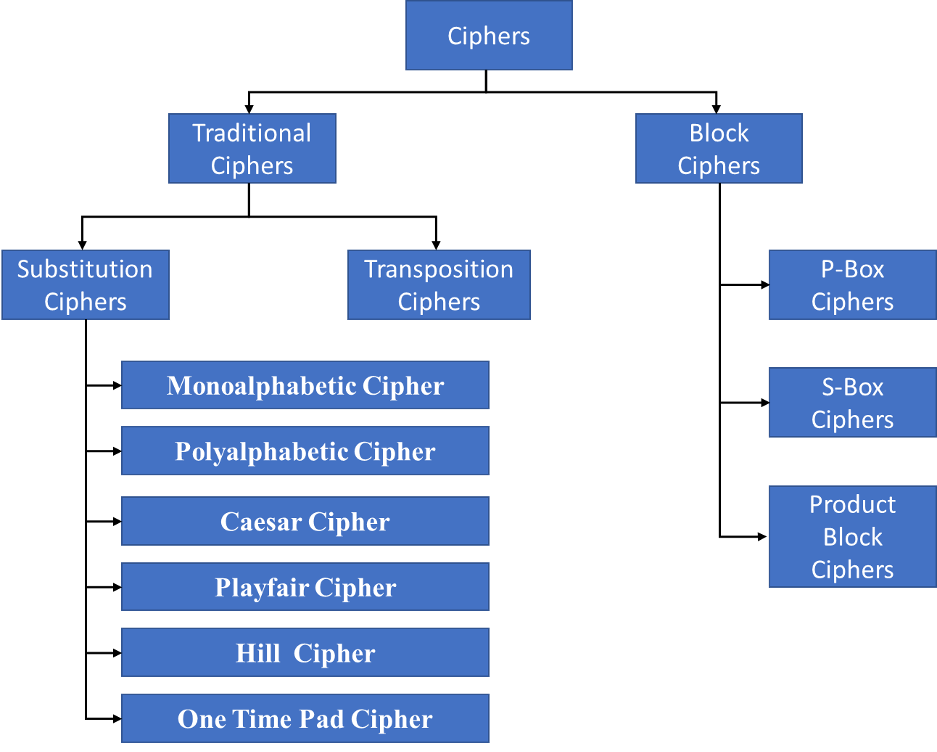
Mainly there are two types of Cipher as given below:
Block Ciphers
Traditional Ciphers
Block Ciphers
These are new technologies. In this a text block is transformed or replaced with a cipher text block instead of single character transformation.
These are again divided in three categories:
P-Box
S-Box
Product Block
P-Box or Permutation Box
Transformation or transposition is performed on bit level.
Plaintext is transformed with digital Bits such as 1 and 0.
The size should be similar in both plain text or cipher text.
S-Box or Substitution Box
Substitution is performed at bit level. It contains three things:
Decoder: Decoder transform n-bit into 2n bit structure.
P-Box: P-box perform permutation on this decoded data.
Encoder: The encoder is used to transform the permuted data into cipher text.
Product Block
If we want more reliable and secure cipher then we can combine P-Box and S-Box to create new cipher, known as Product Block.
It applies both the processing on the plain text for transformation into cipher text.
These are the earlier ciphers. These have simple mechanism. Most of traditional ciphers use single alphabet or character as a unit for transformation. Means one plain text alphabet is replaced with one cipher text alphabet.
These are again divided in two categories:
Substitution Cipher
Transposition Cipher
Substitution Ciphers
As name implies the current letter, character, alphabet, number, bit is replaced by some other letter, character, alphabet, number, bit as well. The replacement maybe applied on a single character or a block of characters. let’s look at their sub parts:
1. Monoalphabetic Cipher
Single character is replaced with single alternate character throughout the whole data set. For example, if for a particular data set A is considered as H, then at everyplace letter A is used, that will be replaced with H.
This is an easy method but to find the key is very difficult so this is a good cipher.
Even we can arrange the whole alphabet set to new alternate values as given below:
Example:
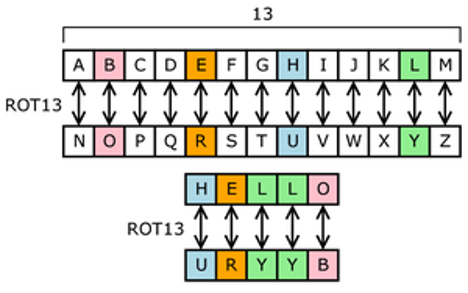
Plain text: Cipher is an algorithm.
Cipher text: PVCUREVFNANYTBEVGUZ.
2. Polyalphabetic Cipher
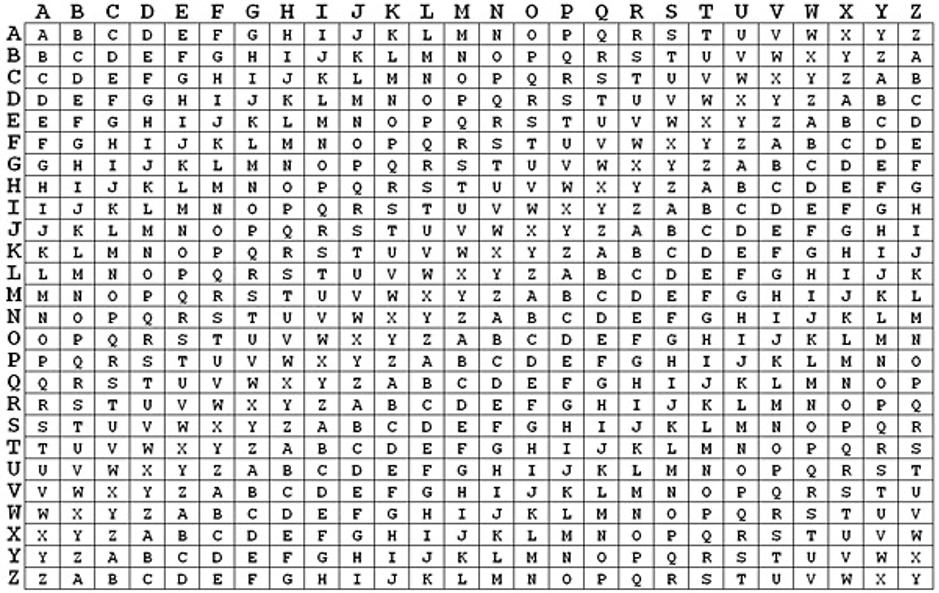
In this Vigenere square or Vigenere table is used.
In this table multiple alternates are existing for single character.
The final alternate is depending on the character and the keyword to encrypt the text.
for transformation a key is also used and this key is different for each dataset.
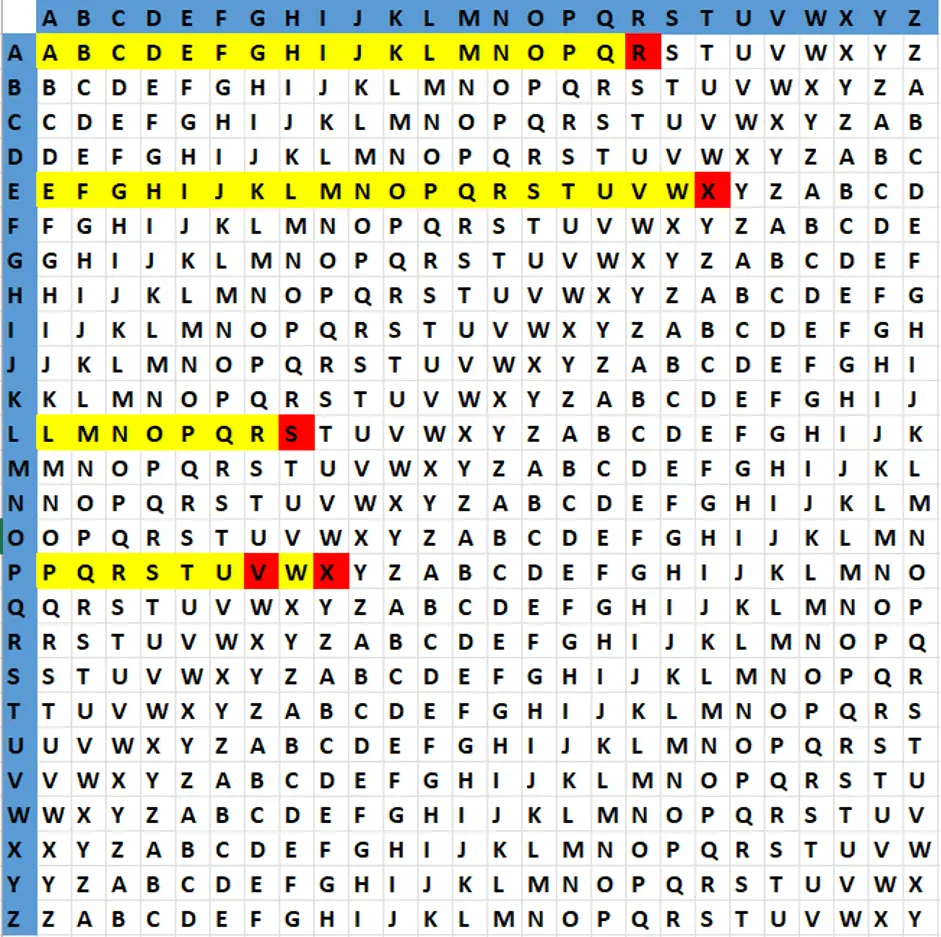
For example, take a plain text APPLE and the keyword is RIGHT, so now A is used with R, P is used with I, second P is used with G, L is used with H, and E is used with T.
A = R
P = I
P = G
L = H
E = T
Now for convert A go for row A and column R. the cross value is R.
Now repeat the process for all the alphabets so the values are:
A = R
P = X
P = V
L = S
E = X
So, Apple is encrypted as RXVSX.
3. Caesar Cipher
This is very simple. In this each alphabet is replaced with its upcoming third subsequent alphabet.
Example: A is replaced by D, B is replaced by E etc.
let’s transform word Cipher:
C = F
I = L
P = S
H = K
E = H
R = U
So, Cipher is transformed in FLSKHU.
4. Playfair Cipher
In this a Playfair square is used, which is 5 X 5 in size.
Steps are as follows:
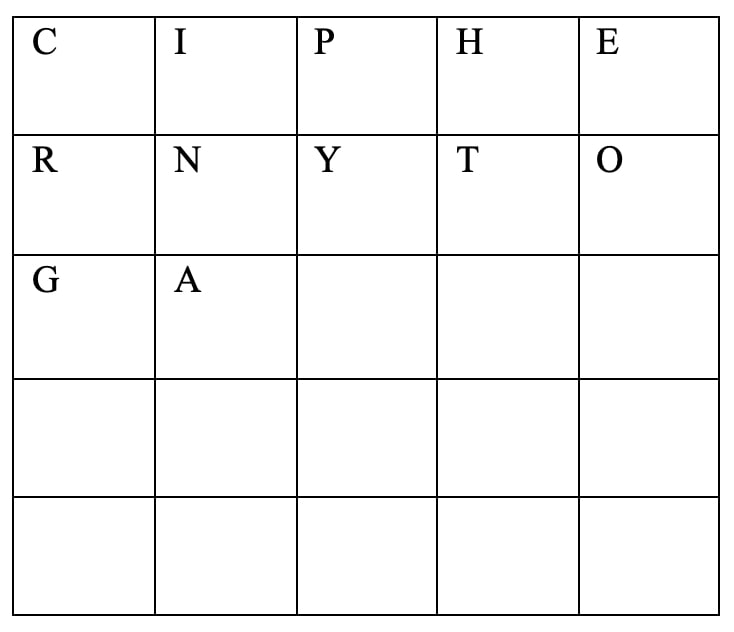
First choose a keyword of your own choice. For example, choose “cipherincryptography” (cipher in cryptography)
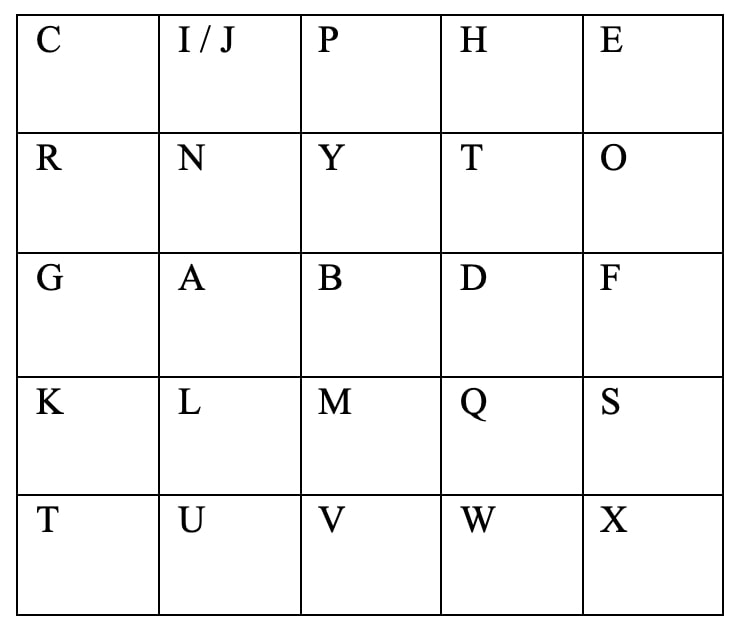
Now enter the characters in the 5 X 5 matrix.
Avoid the repeated word.
Fill I and J in one cell.
A B C D E F G H I J K L M N O P Q R S T U V W X Y Z
Enter the keyword “cipherincryptography”
Now enter the remaining alphabets from A B C D E F G H I J K L M N O P Q R S T U V W X Y Z
Now the matrix is ready.
For transformation follow the rules:
Break the given words in alphabet sets. Each set should have 2 alphabets.
If in any set both alphabets are similar then write the alphabet one time and add X.
If a single letter is existed then add Z.
If both alphabets are available in same row, then replace them with their just next right alphabet.
If both alphabets are available in same column, then replace them with their just next below alphabet.
If both alphabets are not in same row or same column then swap them with their just right or left alphabets but with other corner of the cube.
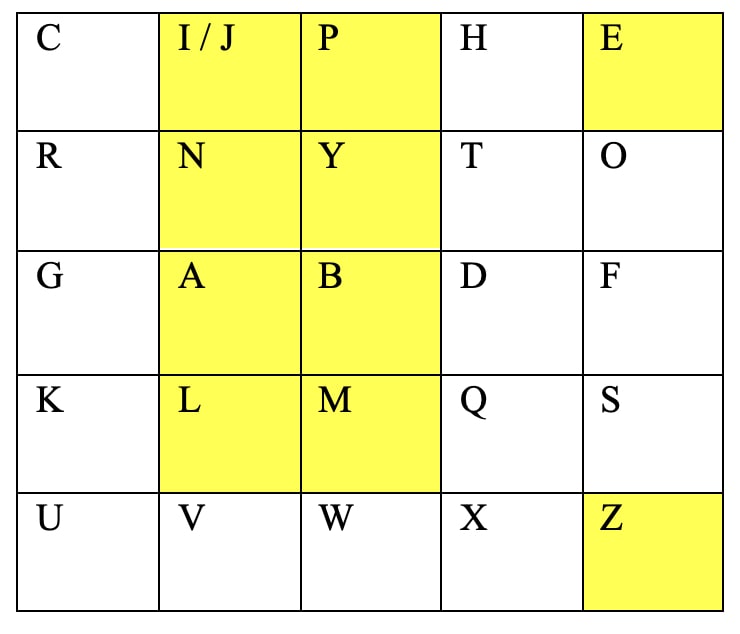
For example, choose word Apple:
Apple = AP PL EZ
AP = BI (We can choose any either I or J)
PL = IM
EZ = OE
So, Apple is encrypted as BIIMOE.
5. Hill Cipher
This is a complex mathematical algorithm to encrypt the data.
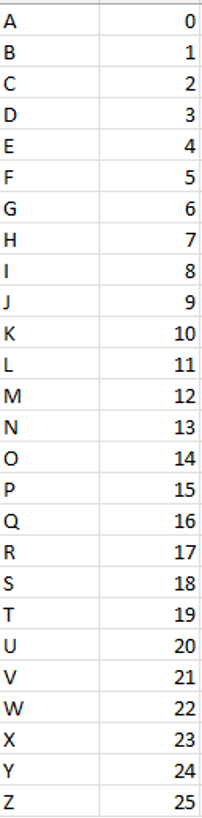
First apply numbers to alphabets such as:
Then choose a key matrix (m*n) size.
Then choose the word to encrypt.
Break the word in size equal to key matrix.
Now convert the word matrix in number matrix.
Now find the cipher matrix by using this formula:
C = KP mod 26
Here C = cipher matrix
K = key matrix.
P = word matrix
now transform the cipher matrix into word matrix.
Follow the process for the whole data set.
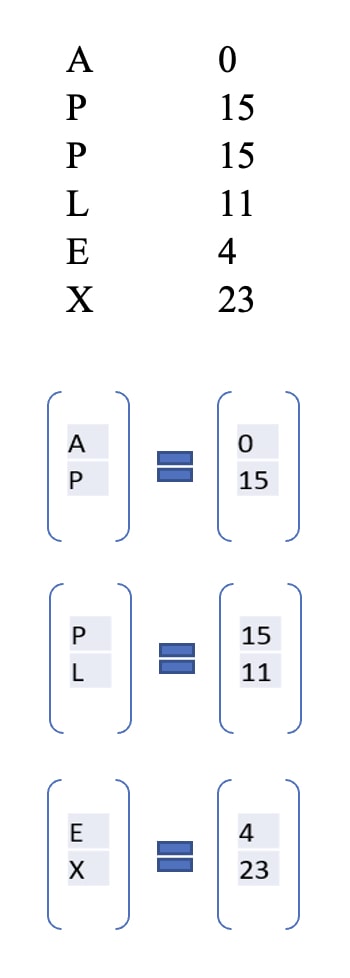
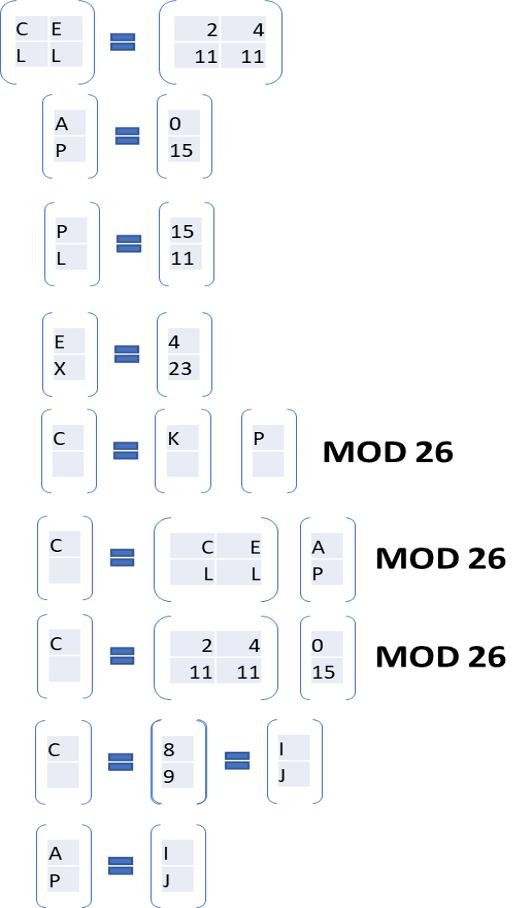
Example: We choose word Apple to transform. Convert the alphabets into numbers from the above-mentioned table.
The size of word matrix is equal to the size of key matrix. Hence 1 X 2.
Now choose a keyword:
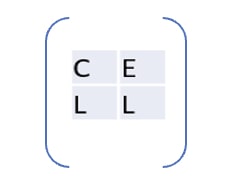
We choose CELL as key word.
Plot it in matrix. Cell has four characters so the matrix will be 2 X 2 in size as given:
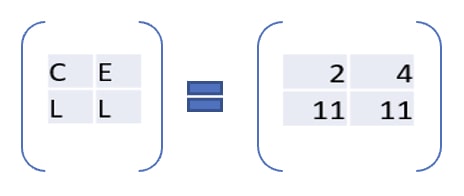
Now convert it into number matrix:
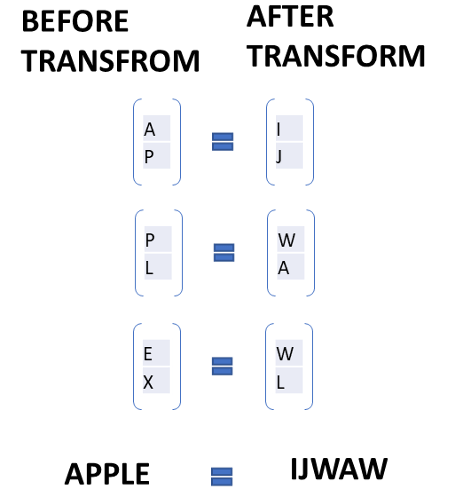
Repeat the process for other two word matrix.
The final transformation will be look like this:
So, this is the method of Hill cipher. It’s quite lengthy and complex.
6. One-time Pad
It is similar like substitution cipher but here original alphabets are replaced with the same size keyword. Means size of plain text and keyword is similar. The keywords are generated on random basis. Each keyword used once only.
It is impossible to crack the code due to multiple combinations.
Transposition Cipher
In this the order of the given word is being changed. The given words are placed in a m*n matrix, and then the alphabets are replaced with the subsequent alphabet. The interval is chosen as per the key.
For example:
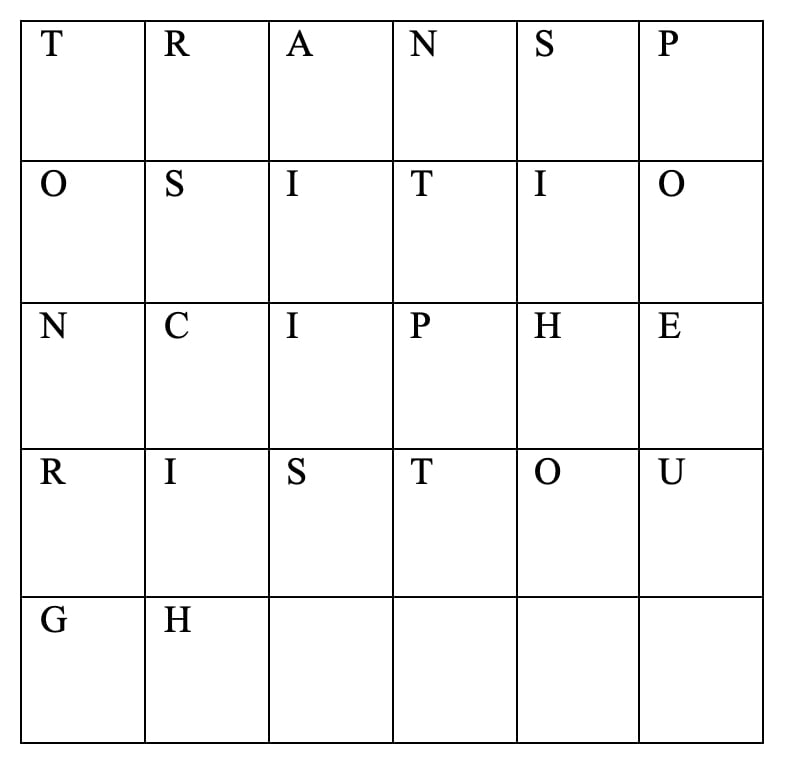
Transposition cipher is tough and the secret random key chosen is 6. Now create a matrix with 6 column and required rows.
And place the given string in it.
Now our key is 6, so replace T with subsequent 6 alphabet in the given matrix.
So, T = O
Now change the whole string with the same procedure.
Plain Text Cipher Text
Transposition cipher is tough = OSITIONCIPHERISTOUGHTRANSP
Additional Ciphers
1. Polygraphic Cipher
It is similar as substitute cipher, but in this plain text blocks are replaced with cipher text blocks instead of individual letters or characters.
The plain text is divided in larger groups. Each group is replaced with same size cipher text block.
Playfair and Hill cipher are the example.
2. Permutation Ciphers
This is quite opposite of substitute ciphers. In this the plaintext is rearranged in any possible order.
Permutation simple means rearrange the order of characters and alphabets in plain text.
Example:
Hey is a plaintext. Now find its permutations:
H E Y are three letters so number of total possible permutation is:
3 X 2 X 1 = 6
So, let’s find these 6 permutations manually by rearrange the order.
Hey
Eyh
Yhe
Hye
Ehy
Yeh
Now we can use any permutation instead of Hey. This is permutation cipher.
3. Private-key Cryptography
In this method a Private key is used for encryption and decryption.
This key should be same for the encryption or decryption of the same text or data.
This key is shared between the sender and receiver of the text.
4. Public-key Cryptography
In this method two different keys are used for encryption and decryption.
First key is used to encrypt the plain text into cipher text. This key is called the Public key.
Second key is used to decrypt the cipher text into plain text. This key is called private key.
Here we tried to cover all popular types of ciphers in cryptography. In case you have any queries or suggestions please mention in the comment section below.
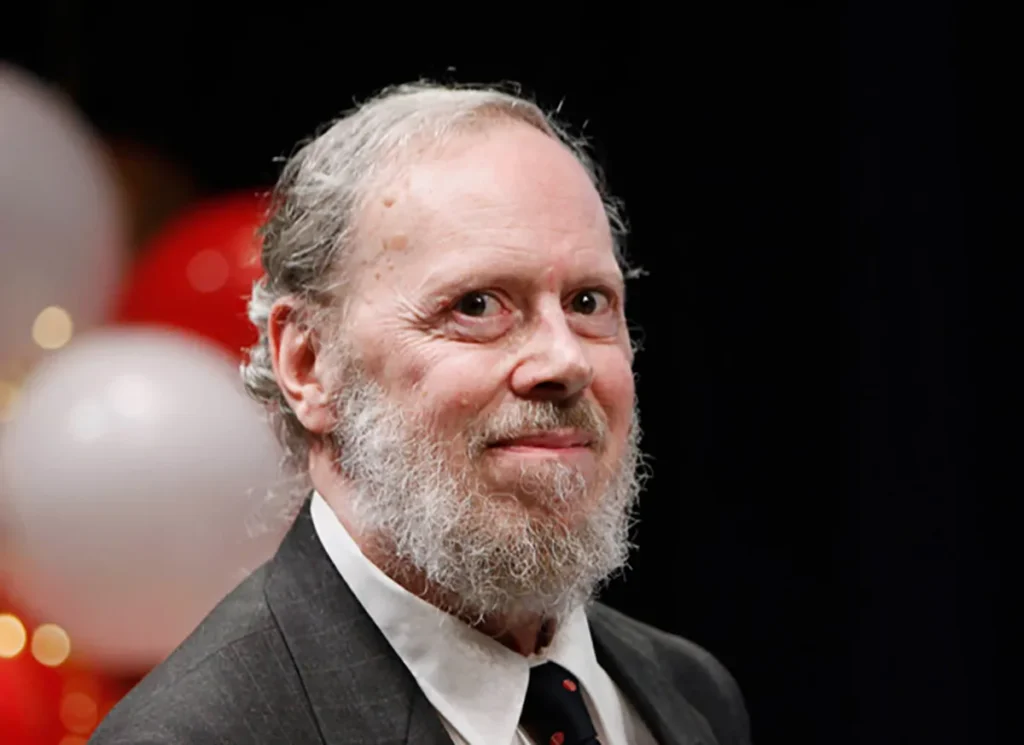
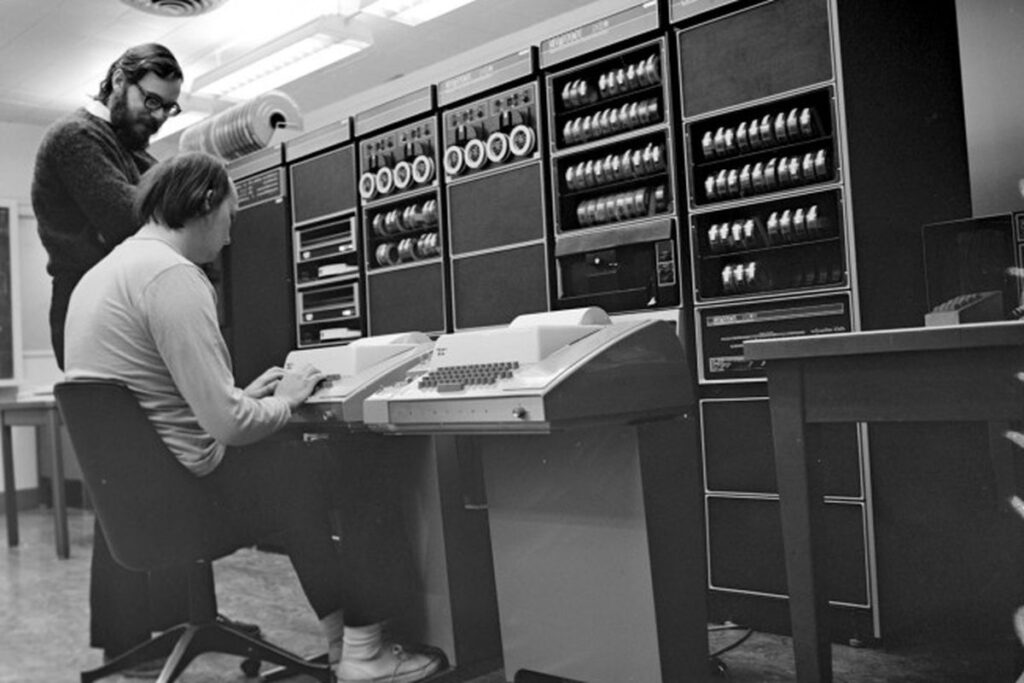
Dennis Ritchie, a computer scientist is most popularly known for creating the C programming language. Dennis grew up in Brooklyn, New York, and attended ‘Summit High School’ in Summit, New Jersey. He was a star student in the classroom, earning consistently good grades.
He went on to study applied mathematics and physics at Harvard University. When he started working at Bell Labs in 1967, he began working on his PhD. However, he was not able to complete his education. At Bell Labs he made friends with Ken Thompson and together they began developing the ‘Multics’ operating system. Dennis invented the programming language ‘C’ and the operating system ‘Unix’ while working at the University of California, Berkeley.
Over time, Unix operating system gained popularity, and C programming language became the most widely used. Dennis and his colleague Ken Thompson received a ‘Turing Award’ in 1983 for their contributions to computer science field. Along with the “National Medal of Technology,” Dennis and Ken were honored with Japan’s “Japan Prize for Information and Communications Technology.”
Childhood & Early Life
Alistair E. Ritchie and Jean McGee Ritchie welcomed Dennis MacAlistair Ritchie into the world on September 9, 1941, in Bronxville, a wealthy New York City neighborhood. Bill and John were his older brothers, and he also had a sister named Lynn as a younger sibling. During Dennis’s childhood, his father had worked for a company called Bell Labs for many years.
Among the scientific world, he was well-known for his contributions in the field of electrical engineering. Co-authoring the book on switching circuit design was another notable accomplishment for him. Dennis’s mother was a stay-at-home mom who raised him in that role. Dennis was just a few years old when his family relocated to Summit, New Jersey. At the ‘Summit High School,’ Dennis began his education. He’d been curious about his father’s job since he was an adolescent.
He was a talented student in his own right. High school grades were strong enough to get him into Harvard University, which is known for its applied mathematics and physics programs. During high school, he developed an interest in computer science. When he was in high school, he heard a presentation that demonstrated how ‘Univac I’, Harvard’s first computer system, was used. Seeing Dennis’s reaction piqued his interest in computers. Amidst his studies at ‘Harvard,’ he became interested in computers.
Career & Development of C
While working at MIT, Dennis discovered that computers at the time were enormous, and that a single computer occupied nearly the entire room. He began developing an operating system for handheld computers. There were no operating systems available for the few tiny computers that were built. As a result of Dennis’s efforts, a computer program for personal computers was born. He wanted to reduce the size of a computer without compromising its functionality.
Many institutions, including MIT, Honeywell, and GE, came out in support of his initiative. The cooperation of many scientists and computer experts was also critical to Dennis’s success. After he graduated from Harvard, his project was over. He was certain that he wanted to work in computer science rather than physics. His outstanding portfolio made it easy for him to get hired at Bell Labs.
Bell Labs was one of the world’s most advanced research facilities in 1967. This had been his father’s place of employment for a long time. A telephone service provider named after Graham Bell at the time of its establishment in the United States. Many computer-related breakthroughs were made possible because to the work done at this facility. However, there was no computer related professional degree at the time. To help him learn on the job, Dennis began working with more experienced computer scientists.
Another young computer scientist, Ken Thompson, had joined Bell Labs around the same time Dennis did. Dennis and Ken worked together and became friends. When the C programming language was introduced, it was a game changer. All but a handful of computer programmers now use it. Most modern computer programs are written in C since it was so advanced for its time.
C is a very simple programming language, but it is well-structured and modular, making it ideal for creating computer programs. By the mid-1980s, it had become a widely used programming language throughout the world, with many major multinational corporations (MNCs) switching to C. When Bell Labs was rebranded Lucent Technologies in 1990, Dennis was hired to lead the Computing Techniques Research Department.
New computer programs were written by him, and he was in charge of the rapid expansion of the operating systems that were previously available. There are numerous accolades and honors that Dennis has received throughout his career.
Family, Personal Life & Death
Dennis Ritchie never had a wife or a family of his own. His death occurred at his residence in New Jersey on the 12th of October, 2011. Heart disease and prostate cancer were ravaging him. When he died, he was 70 years old. The passing of Steve Jobs, who had died a week earlier, overshadowed news of Jobs death.
C’s development was made possible by Dennis’s lack of a solid educational background, which allowed him to investigate all possibilities, even those that went outside the boundaries of conventional schooling. He probably wouldn’t have pushed outside his comfort zone if he had a computing background.
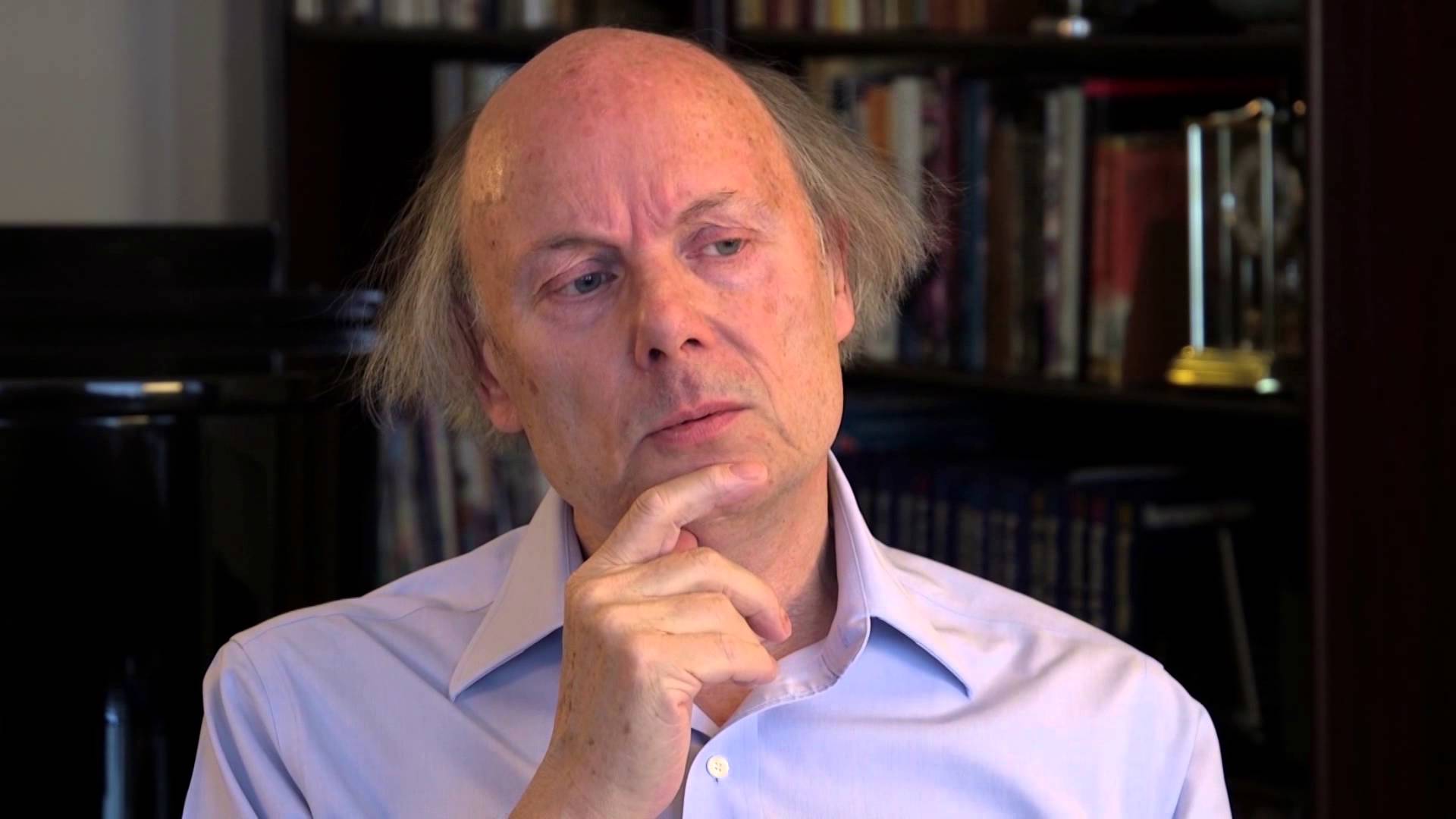
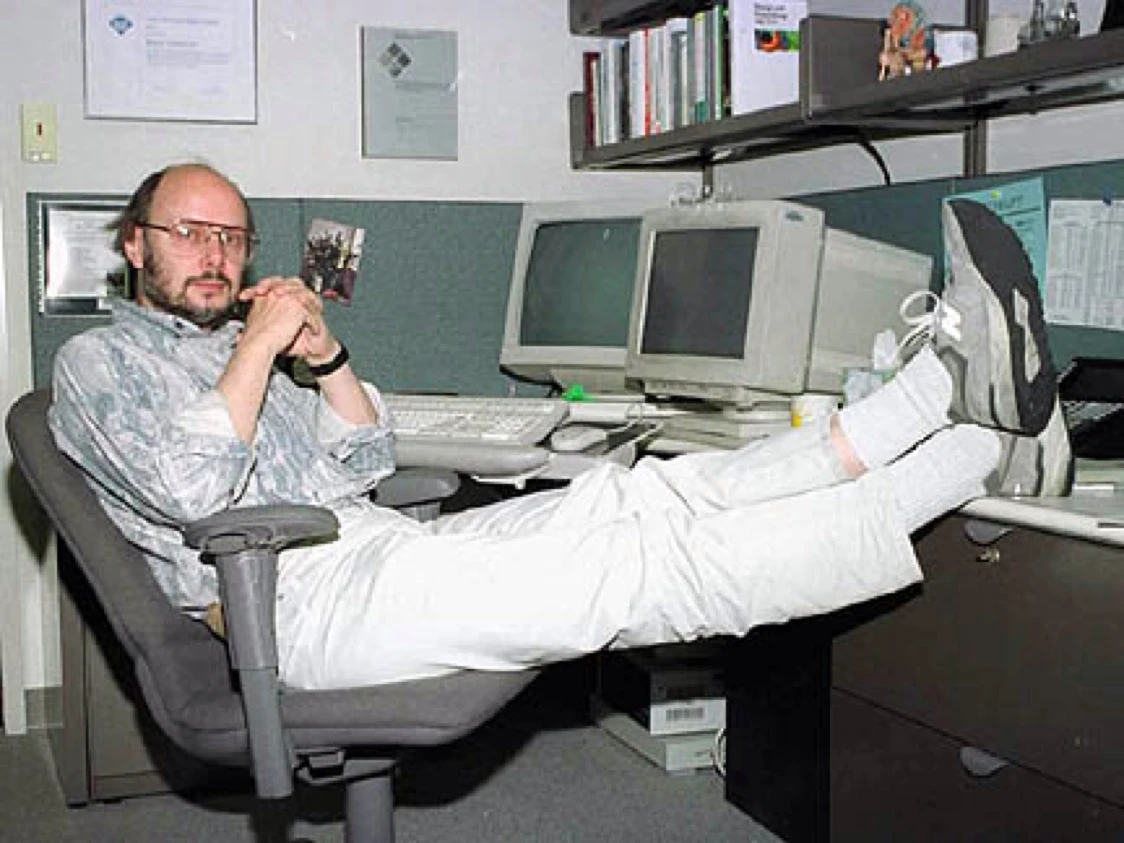
Bjarne Stroustrup, a Danish computer scientist, was born in Copenhagen on December 30, 1950. His contributions to the C++ programming language and its implementation earned him the lion’s share of his fame. He maintains two careers simultaneously, one as a visiting lecturer at Columbia University and the other as a managing director at Morgan Stanley in New York.
Because of his interest in microprogramming and machine design. From Kristen Nygaard, the original developer of object-oriented programming, he acquired its principles. In 1979, he graduated with a Doctor of Philosophy degree in computer science from Cambridge University.
In addition to being an honorary professor at the University of Aarhus, he is also an honorary fellow of Churchill’s Institute. Between the years 1995 and 2002, Dr. Stroustrup oversaw department’s operations in the field of large-scale programming Texas A&M University’s Chair Professor of Computer Science also serves as a faculty member at AT&T Labs–Research Information and Systems Software Research Laboratory, where he teaches computer science.
Personal Life
Bjarne Stroustrup is a family man who is married and has children. He is married to Marian Stroustrup, the woman he has spent the most of his life with. They are parents of Annemarie Stroustrup and Nicholas Stroustrup, both of whom are their children. One might say that he is the kind of person who has spent their whole life working on and developing things that would help future generations.
This describes the sort of person that he is. In addition to this, he is quite protective of the privacy of his personal life and is anxious about how others would see him in general. This gentleman is kind, and he treasures the time he gets to spend with his loved ones.
Early Life and Education
Stroustrup was born in the city of Aarhus in Denmark. His parents were in the working class, therefore they enrolled him in the local public schools. He got themaster’s degree from Aarhus University in mathematics and computer science. The design of machines and microprogramming piqued his curiosity.
Kristen Nygaard, the program’s designer, was a frequent visitor to Aarhus and taught him the principles of object-oriented programming, where it was earned under the supervision of David Wheeler. His studies concentrated on distributed computer systems and the means through which its components may interact with one another.
Career
His parents were in the working class, therefore they enrolled him in the local public schools. Stroustrup started his career in the field of computer. During his time at the university, he started his education in C++ and other programming talents. Since the beginning of the Large-scale Programming Research department until the very end of 2002, Stroustrup served as the department’s leader and was in control of its operations.
He was promoted to the position of University Distinguished Professor in 2011. Since January 2014, Stroustrup has held the position of visiting adjunct professor at the computer science department at Columbia University, in addition to his work at Morgan Stanley’s technology division in New York City as a technical fellow and managing director.
Prior to the year 2002, he held the position of director of the large-scale programming research unit at AT&T Bell Labs. Following his tenure as a fellow at Bell Labs in 1993, he was promoted to the position of AT&T Fellow in 1996.
C++
Stroustrup is most well-known for the work he did on the C++ programming language. C++ was originally developed by him in 1979, and ever since then, it has seen consistent development and improvement (initially called “C with Classes”). He was the one who expressed it in this manner: “built the original implementation of C++ based on his own ideas and conceptions. design requirements, constructed all of C++’s core capabilities, and was responsible for the processing of extension proposals in the C++ standards committee.” C++ was first made available to the public in 1985 and has since gained significant traction.
Before widespread availability of Internet connection, shipping charges in the amount of $75 USD were fronted as a charitable contribution in exchange for Stroustrup’s C++ Programming Language was published as a book the same year it was first made available, in 1985. Simula-inspired C++ offers a broad variety of abstraction techniques that can be efficiently translated to computer hardware and can be done so in a straightforward manner.
Software development was revolutionised as a result of the ability to apply a broad variety of methodologies. This made it feasible to create software in a more efficient manner. Even though they have been around for a long time, programming languages such as C++ are still widely used in a variety of fields. These fields include general system programming, computer, a wide range of applications include graphics, graphical user interfaces (GUI), embedded systems, financial systems, aviation, and scientific calculation.
Programming languages such as C++ are among the most widely used in the world. Its influence can be felt around the globe, not only in the C++ community where it was developed. Over the course of twenty-four years, he served as chairman of a committee that was responsible for.
Honours and Distinctions
Over the course of his illustrious career, Stroustrup has been honoured with a number of prestigious awards, including IET faraday medal. He was granted fellowships from the ACM and the IEEE in addition to his membership in the NAE. In recognition of his many accomplishments in the field of electronic design, Stroustrup is the author of a large number of books and articles, the most notable of which are 2019 was the year that the University Carlos III of Spain bestowed an honorary degree upon him.
Fellowships
Following his selection in 2004, he was inducted into the National Academy of Engineers.
An ACM Fellow since 1994, when I was elected to that honorary title.
In 1994, he was presented with the IEEE Fellow Award, which is the organization’s highest honour.
Computer History Museum Fellow in 2015 for contributions to C++ programming language innovation.
In 2017, Churchill College in Cambridge bestowed upon me the title of Honorary Fellow.
Doctorates and Professorships Conferred with Honour
The University of Carlos III of Spain awarded him an honorary degree in 2019.
Since 2013, Dr. Stroustrup has been a moral doctor at ITMO University.
His Books
A Tutorial on the C++ Programming Language
Programming in C++: Theoretical Foundations and Real-World Applications
How to Write Programs Using the C++ Language
C++: The Evolution of Its Programming Language
The Annotated Reference Manual for the C++ Programming Language
These books are currently accessible in translation in a total of twenty-one different languages at this time.
Facts That May Interesting to Know
As a consequence of his significant contributions to the disciplines of computing and information, Upsilon Pi Epsilon bestowed upon him the Golden Abacus Award in the year 2013.
In 1990, Bjarne Stroustrup was selected by Fortune Magazine as one of the best 12 young scientists in the United States. Among those who were recognised for their Claude Shannon, a mathematician, engineer, and cryptographer, made significant contributions.
He used programming methodologies in a variety of contexts, including general systems programming, switching, simulation, graphics, user interfaces, embedded systems, and scientific calculations.
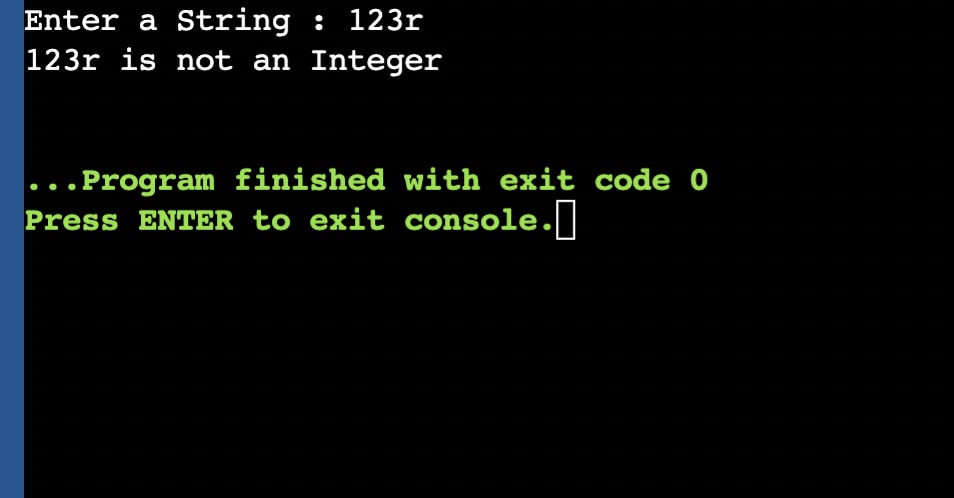
In this article, we will write a program in python that will check if a string is an integer or not.
We will create a function that will take a string as input and returns a Boolean value (true or false) based on the condition if it is an integer or not. We will take the input from the user and call the function. After storing the result, we will print on the console whether the string is an integer or not.
If all the characters of an inputted string are between ‘0’ and ‘9’, then it means that the string is an integer.
For Example:
123, It is an Integer because all the characters are between 0 and 9.
35446554667876832, It is also an Integer because all the characters are between 0 and 9 only.
234t5, It is not an Integer because it contains a character ‘t’ which is not between 0 and 9.
If any character is not following the rule, then we can consider that the string is not an Integer.
# Function to check if a string is Integer of Not
def checkInteger(str1):
    """
    Function to returns if a string is Integer or Not
    Input : String value
    Output : Boolean Value ( True or False )
    """
    length = len(str1) # Find the length of the string
    # loop from 0 to length - 1
    for i in range(0, length):
        # if the character is not greater than 0 and less than 9
        # it means that the string contains any alphabetic character
        # so it is not an integer. In this case return False
        # otherwise return True after checking all the characters
        if (not (str1[i] >= '0' and str1[i] <= '9')):
            return False

    return True

# Take string as input from the user
str1 = input("Enter a String : ")

# Call the function and store the result
result = checkInteger(str1)

# If result is True then print that it is an integer
# Else print that it is not an Integer
if (result):
    print(f"{str1} is an Integer")
else:
    print(f"{str1} is not an Integer")
Testcase 1: When the input is 123.
Output:
PS C : \ Users \ ASUS \ Desktop \ Crazy Programmer Work > python -u " c : \ Users \ ASUS \ Desktop \ Crazy Programmer Work \ test.py "
Enter a String : 123
123 is an Integer
Testcase 2: When the input is 236r.
Output:
PS C : \ Users \ ASUS \ Desktop \ Crazy Programmer Work > python -u " c : \ Users \ ASUS \ Desktop \ Crazy Programmer Work \ test.py "
Enter a String : 236r
236r is not an Integer
If all the characters of a string are between 0 and 9 then we can say that the string is an integer otherwise it is not considered an integer. We have seen the program for the same where we created a function that takes a string as input and tells us if the string is an integer or not.