As our main character learns more about cybersecurity, a constantly changing and growing field, they are amazed by the potent blend of artificial intelligence and digital defense. This coming together is like a symphony of complicated algorithms or a complicated dance where people and machines work together.
AI has become a digital superhero that keeps our virtual worlds safe by being able to recognise threats and act on them automatically. Join our main characters on this journey as they discover the exciting worlds of cybersecurity and artificial intelligence (AI). Together, they will find the amazing things AI can do, look into possible risks, and cast light on a bright future as we look for new ways to keep our digital world safe.
AI is a key part of finding and stopping online threats faster and more accurately than ever. Machine learning algorithms look at a lot of data for trends and outliers that could be signs of bad behaviour. AI-powered systems like Daitaku can adapt to new risks and keep you safe in real time because they always learn from new data.
These smart systems are great at finding known software, but their real power is in finding threats that haven’t been seen before or are changing. AI can spot odd behaviour, such as unusual network traffic, attempts to get in without permission, or strange user actions. This lets you stop threats quickly and proactively.
Unsecured Wi-Fi Networks
Unsecured Wi-Fi networks are a major threat to our online safety that we don’t see. Without encryption, these networks leave us open to hacking and data theft. However, ExpressVPN says that we can reduce these risks by using a VPN. VPNs link our devices to the internet in a safe and encrypted way. This keeps our online actions from being tracked by people who don’t want to see them. With this extra layer of security, we can use Wi-Fi in public places with confidence, knowing that our personal information is safe. In today’s linked world, it’s important to prioritise VPN use if we want to protect our privacy and stay in charge of our digital lives.
Advanced Behavioral Analysis
According to ZDNet, AI’s cybersecurity opportunities, challenges, and ethical considerations are complex and evolving. AI gives cybersecurity systems the ability to understand and analyse user behaviour, which makes it possible to spot possible insider risks or accounts that have been hacked. AI systems can spot deviations from normal behaviour and flag suspicious actions that may be signs of a cyberattack if they don’t fit with what’s expected.
Machine learning models look for strange things in how users act, like sudden access to secret information or strange data transfer patterns. These early signs give security teams time to look into and deal with possible risks before they do a lot of damage.
Automated Incident Response
With cyber risks getting worse constantly, it’s important to act quickly. AI automates incident reactions, making finding, stopping, and quickly fixing security breaches easier. AI-powered systems can look at and connect a lot of data from various sources, giving security teams information they can use.
Automated incident reaction cuts the time between finding a threat and doing something about it. This makes attacks less damaging. AI can also take predefined steps to protect itself, like isolating compromised devices or blocking suspicious network traffic, while telling human workers to investigate the situation further.
Enhanced Phishing Detection
Phishing attacks are still a big worry for both people and businesses. AI makes it easier to spot phishing by looking at the content of emails, how the sender acts, and other details about the context. Machine learning algorithms can find patterns and traits common in scam emails and flag them as possible threats before they get to users’ inboxes.
AI systems get better at spotting and stopping fraudulent emails as they learn from new phishing tactics and patterns. This technology helps organisations protect private data, stop unauthorised access, and lower the risks of social engineering attacks.
Threat Intelligence and Predictive Analytics
AI gives defense teams helpful information about threats and ways to predict them. AI can find new threats, predict attack patterns, and provide actionable insights by looking at a lot of data from different sources, such as security feeds, industry reports, and open-source intelligence.
This predictive capability enables organisations to allocate resources effectively, put security measures in order of importance, and stay one step ahead of cybercriminals. By using AI, cybersecurity professionals can make smart choices and come up with proactive plans to protect against threats that are always changing.
Conclusion
Artificial intelligence has completely changed the field of cybersecurity by giving it new ways to find threats, analyse behaviour, respond to incidents, spot scams, and do predictive analytics. As AI keeps getting more intelligent, it could help make cyber defenses even better. But it’s essential to think about what could go wrong.
Alan Turning was a computer scientist and mathematician. His work played a vital role in the development of modern computing and artificial intelligence. During world war 2 he helped to break the German enigma code that resulted in saving millions of lives. His concept of the Turing machine laid the foundation for the modern computer.
In this article, I am sharing some of the best quotes from Alan Turing that I have collected from various sources.
Sometimes it is the people no one imagines anything of who do the things that no one can imagine.
Those who can imagine anything, can create the impossible.
We can only see a short distance ahead, but we can see plenty there that needs to be done.
A computer would deserve to be called intelligent if it could deceive a human into believing that it was human.
If a machine is expected to be infallible, it cannot also be intelligent.
Programming is a skill best acquired by practice and example rather than from books.
Codes are a puzzle. A game, just like any other game.
A man provided with paper, pencil, and rubber, and subject to strict discipline, is in effect a universal machine.
Science is a differential equation. Religion is a boundary condition.
I hope you liked these Alan Turing quotes. Please mention in the comments if you know of any other good quotes by Alan Turing.
Claude Elwood Shannon was born on 30 April 1916 in Petoskey, Michigan, United States. He was an American mathematician, computer scientist, cryptographer, and electrical engineer. His father’s name was Claude elwood shannon Sr. He was a judge and also a businessman. His mother’s name was Mabel Shannon and she was a language teacher later she also worked as a principal. Shonnon’s family lived in Gaylord, Michigan, and Claude Shannon Jr. was born in the hospital near his home. Shannon spent 16 years of his life there.
He completed his schooling at Gaylord high school in the year 1932. He was good at mathematics and science. He completed his graduation from the University of Michigan in 1936. Shannon married a wealthy Jewish Norma Levor in 1940. After one year of marriage, both separated and later Norma married Ben Barzman. Shannon met a girl named Marry Elizabeth Moore (Betty Shannon) and she was a numerical analyst at bell labs. In the year 1949, both got married.
He was very curious about mechanical and electrical things. He made some devices such as models of planes, radio-controlled model boats, etc at home.
Career
After graduation, he obtained a research assistant position at the Massachusetts Institute of Technology (MIT). At MIT he worked with Vannevar Bush on the differential analyzer. During this time he designed switching circuits based on Bool’s concept. In the years 1937, he wrote his master’s degree thesis. It was published in the year 1938. In his thesis, he proved that his switching circuit could simplify the arrangement of the electromechanical relays. These types of arrangements were used in telephone call routing switches at that time. Later he expanded this concept and also proved that it can solve all problems like Boolean algebra.
Shannon joined MIT as a faculty to work Research Laboratory of Electronics (RLE) in the year 1956 to 1976.
Wartime Research
During world war 2 Shannon joined bell labs under a contract of the national defense research committee (NDRC). There he worked on fire systems and cryptography. In the year 1942, he invented signal-flow graphs. In 1943 he met British mathematician and computer scientist Alan Turing. Turing showed his 1936 paper to Shannon which defined the Universal Turing machine.
Shannon published ‘A Mathematical Theory of Communication’ which was built at bell labs with the help of other researchers such as Harry Nyquist and R.V.L. Hartley. His framework and terminology are still used. Shannon invented the message delivery system. Engineers got permission to focus on this system.
Death
The last few years of his life were spent in a nursing home because he had Alzheimer’s disease. Later on Feb 24, 2001, he passed away.
Choosing the right cloud hosting service can be a daunting task. As can be expected, every provider will shout about how unique their products are. But full dependence on their honesty to get the best cloud provider may not be the best choice. Clarity on what to look out for will ease the process.
We will compare Heroku vs. DigitalOcean to decide which is the better option. Both are solid platforms but may differ in ease of use, scalability, customization, and more.
Ease Of Use
There are applicable benchmarks for determining ease of use for cloud hosting services. These include:
Web application deployment time
User interface complexity
The intuitiveness of the platform.
Heroku, which is a platform-as-a-service (PaaS), emerges as the winner, and this is one of its most noticeable attributes. The user interface is simple, and developers can focus on code deployment without having to go into infrastructure management. Heroku streamlines workflow deployment by abstracting away a lot of the infrastructural configurations.
Besides, the fact that it supports a wide range of programming languages and frameworks eases deployment through a few commands. Developers only need to push the code changes onto the platform, which triggers automatic builds and deployment.
DigitalOcean needs manual configuration, thus requiring a level of technical knowledge. Take, for example, Droplet creation, which involves selecting different specifications like the region, sever size, and operating systems. True, that provides a certain level of flexibility. But users must have a basic understanding of processes like server configuration.
Scalability
In terms of scalability, both Heroku and DigitalOcean offer that functionality. But Heroku calls upon its ease of use strength to become the better option here. Depending on the application traffic, the cloud provider uses automatic and dynamic scaling. So even when significant traffic spikes occur, it will automatically provide the necessary resources.
Manual intervention is necessary when scaling up or down with DigitalOcean. Technical know-how is a must, as users must configure load balancing or new servers. The advantage is more control of application scaling, which can result in significant savings. But this is only possible if the traffic patterns are predictable.
Pricing
Digitalocean is a cheaper cloud hosting option than Heroku. The pay-per-resource-used pricing model can be friendlier because it gives users more control. For example, subscribers can determine how much RAM, CPU, or storage space they need and only pay for that. When there is a need to scale upwards or downwards, it will reflect in the price adjustment.
But, such a pricing model will work well for smaller applications, as would be the case with startups. There will have to be adjustments along the way depending on business needs. And that brings in a level of unpredictability in terms of budgeting.
The Heroku pricing model tends to be a bit more complex. Users must pay for a specific number of hours every month based on the dyno hours. There are also optional add-ons like caching or databases that can significantly increase the pricing. But, the subscription model is more predictable, and users can budget better.
Customizability and Control
Some users would rather have a cloud hosting service that gives them control over the infrastructure, including server configurations. In such a case, the obvious choice would be the infrastructure-as-a-service (Iaas), DigitalOcean. Users have the freedom to:
Select different operating systems
Set up user accounts and groups
Install specific software
Configure firewall rules
Create virtual private servers
Configure servers to what they want based on project requirements
Choose the CPU, RAM, and storage based on need, etc.
As a PaaS, Heroku frees up the user’s time by abstracting away much of the infrastructure management. That in itself can be an advantage because they can then focus on the application code rather than worrying about the underlying infrastructure. But, the lack of infrastructure control leaves less flexibility with customizations. This may not work for projects requiring specialized configurations or fine-grained control.
Which is the Better Option?
In the Heroku vs. DigitalOcean supremacy battle, one thing is for sure. Both options are fantastic, with excellent features. Determining which the better option is comes down to the user. DigitalOcean wins in price and user control, while Heroku gets points for ease of use and scalability.
Also, the existing ecosystem and the need for additional integrations matter. If needed, Heroku would work better because DigitalOcean has some core features, but a narrower ecosystem. Thus there may be limitations on add-ons, third-party services, and plugins.
In the realm of technology and business, it is evident that expanding one’s user base is crucial for driving revenue growth. In addition, having a robust cross-platform app has become increasingly essential in today’s rapidly advancing technological landscape. The rationale behind this is quite clear: by creating a cross-platform app, you can effectively reach a larger audience while maintaining cost-effectiveness.
The competitive nature of the digital landscape has posed challenges for developers, compelling them to explore new app development solutions that yield optimal results with minimal effort.
The demand for cross-platform app development frameworks has witnessed a remarkable surge. This surge can be attributed to the fact that cross-platform applications possess a wider reach compared to native apps, offering businesses the opportunity to engage with a larger user base, making it a truly distinctive technology.
As the demand continues to rise, a multitude of exceptional cross-platform frameworks have emerged, empowering developers to craft cutting-edge apps that cater to diverse needs.
We have curated a comprehensive list of the best cross-platform mobile app development frameworks that will undoubtedly propel your business growth in the year 2023.
1. Sencha Ext JS (Formerly Sencha Touch): Enterprise App Development
Sencha Ext JS (Sencha Touch) serves as an invaluable asset for the development of expansive business applications. This cross-platform app development framework proves to be an optimal choice, especially for those seeking seamless integration with Cordova and PhoneGap.
One of Sencha Touch’s most remarkable attributes lies in its ability to streamline the development process of complex business apps. Its popularity among app developers stems from its facilitation of the creation of interactive, native-looking themes.
Advantages of Sencha Ext JS:
Extensive UI Collection: Offering a vast array of more than 50 pre-built and customizable UI widgets, Sencha Ext JS equips developers with an abundant set of visual elements.
Robust Backend Data Package: Leveraging a powerful backend data package, this framework enables efficient management and manipulation of data, ensuring smooth operations.
Seamless Native API Integration: With built-in support for Cordova and PhoneGap integration, Sencha Ext JS simplifies the utilization of native APIs and facilitates smooth packaging processes for deployment.
2. React Native: The Shining Star in Cross-Platform Development
When discussing the top cross-platform mobile development frameworks, it is impossible to overlook the prominence of React Native. Esteemed for its versatility, React Native has become a preferred choice for both iOS and Android platforms. Since its inception in 2015, it has fueled remarkable growth within Facebook’s developer community.
Built on JavaScript, React Native delivers a native-like experience across iOS and Android devices. Its foundation in JavaScript empowers developers to create intuitive user interfaces with ease.
Despite its JavaScript foundation, React Native diverges from conventional approaches by eschewing the utilization of HTML technology, WebView, and CSS. Instead, the framework employs CSS-like polyfills and JSX to define its components. Notably, React Native does not rely on a DOM API.
The key advantage of this cross-platform app development framework lies in its seamless amalgamation of the formidable capabilities of ReactJS and JavaScript. Moreover, developers have the flexibility to incorporate elements in Java, Swift, or Objective-C as per their requirements.
Advantages of React Native:
Unparalleled User Interface: With a steadfast focus on user interface development, React Native empowers developers to construct highly responsive and engaging UI interfaces.
Vibrant Open-Source Community: Being an open-source cross-platform software, React Native boasts a vibrant community of developers. This thriving community ensures a wealth of resources and support for developers working on their mobile app development projects.
Code Once, Run Anywhere: React Native’s hallmark characteristic is the ability to code once and run on multiple mobile operating systems, including iOS and Android. This efficiency saves significant development time and effort.
Device Diversity: React Native enables the design of mobile apps for a wide range of devices, spanning iOS and Android platforms, including Android TV, MacOS, tvOS, and more. Additionally, it extends its reach to the creation of flawless applications for UWP and Windows.
Extensive Plugin Compatibility: React Native seamlessly integrates with an array of popular third-party plugins, including the widely used Google Maps plugin, expanding its functionality and versatility.
3. PhoneGap: Dominating the Market for Cross-platform App Frameworks
In 2005, PhoneGap was initially developed by Nitobi Software, and after six years, Adobe acquired it, rebranding it as Adobe PhoneGap. Today, PhoneGap, also known as Cordova, stands as the unrivaled leader among cross-platform app development frameworks, boasting the largest market share. Its exceptional utilization of HTML, CSS, and JavaScript has earned it a stellar reputation in the realm of mobile app development.
One of PhoneGap’s standout features is its robust back-end infrastructure, which plays a pivotal role in enhancing its performance and speed. As a result, PhoneGap serves as an excellent solution for creating basic apps without native capabilities. It seamlessly supports all built-in device functionalities, while also empowering the creation of remarkable applications.
Advantages of PhoneGap:
Embedded Payment Systems: The PhoneGap cross-platform app development framework empowers users to integrate embedded payment systems, such as Google Play and App Store, into their applications.
Reliable Performance Across Mobile OS: PhoneGap-created apps demonstrate reliable performance across all major mobile operating systems, ensuring a consistent user experience regardless of the platform.
Flexible Interaction Control: With PhoneGap, developers have the freedom to control app interactions using JavaScript or other frameworks like MooTools and Sencha Touch. This versatility enables the creation of engaging and interactive user experiences.
Expandable APIs: PhoneGap’s design is highly modular and plugin-friendly, allowing developers to expand the application programming interfaces (APIs) in a seamless and efficient manner, further enhancing the functionality and versatility of their apps.
4. Corona SDK: A Preferred Choice Among Programmers
When it comes to seamless mobile app development across multiple platforms, look no further than Corona SDK. This cross-platform open-source app development framework offers a remarkable solution that enables developers to create flawless mobile games and applications with unmatched efficiency, boasting development speeds up to 10 times faster.
Corona SDK builds upon the strength of Lua, a versatile and lightweight programming language. With Corona SDK, you have the power to build games for various platforms, including iPads, desktop computers, connected TVs, and more.
Advantages of Corona SDK:
Extensive Plugin Support: Corona SDK comes equipped with a wide range of plugins catering to media, analytics, in-app advertising, and other crucial functions. These plugins enhance the capabilities of your applications, enabling you to deliver rich and engaging user experiences.
Swift and Powerful: As mentioned earlier, Corona SDK is built on the Lua programming language, which imparts impressive speed and power to the framework. With Corona SDK, developers can swiftly execute code changes and see real-time updates, facilitating a smooth and efficient development process.
Rapid Responsiveness: The cross-platform nature of Corona SDK ensures that the framework quickly responds to code changes, allowing developers to monitor and adapt their projects in real time. This responsiveness enhances productivity and enables developers to deliver high-quality applications efficiently.
Corona SDK stands as a reliable choice for programmers seeking to create exceptional mobile experiences across a multitude of platforms, thanks to its extensive plugin ecosystem, swift development capabilities, and real-time responsiveness.
5. Ionic: The Epitome of Excellence
When it comes to cross-platform mobile development frameworks, Ionic stands tall as the undisputed leader. Built on AngularJS, this open-source framework has captured the hearts of developers since its inception in 2013, thanks to its exceptional features and capabilities. Ionic’s core components consist of Apache Cordova and AngularJS, forming a robust foundation for creating remarkable applications.
By adhering to Apache Cordova principles, Ionic enables the development of hybrid HTML apps. These applications operate within a customized shell on mobile devices, utilizing WebView for Android and UIWebView for iOS. This approach combines the best of both worlds, providing a seamless user experience and access to device functionalities.
The true strength of Ionic lies not only in its technical prowess but also in its ability to empower developers to craft user-centric features and visually stunning interfaces. The captivating user interfaces built with Ionic not only captivate users but also keep them engaged for extended periods. Such is the level of native-like performance that Ionic is also a preferred choice for Progressive Web App (PWA) development.
Advantages of Ionic:
Extensive UI Component Library: The Ionic framework offers a vast collection of ready-to-use UI components, allowing developers to quickly create visually appealing and feature-rich interfaces. This library accelerates development and ensures a consistent and polished look across different platforms.
Familiar Technology Stack: To leverage the power of Ionic, developers need to be proficient in CSS, HTML, Angular, and JavaScript. By utilizing these widely adopted web technologies, developers can leverage their existing skills and knowledge, making the learning curve smoother and development more efficient.
Native Feature Integration: Ionic provides a rich ecosystem of plugins that seamlessly integrate with native device features. This allows developers to harness the full potential of smartphones, accessing functionalities like camera, GPS, push notifications, and more, enriching the user experience and expanding the capabilities of their applications.
Mobile-Centric Design: Built on the SAAS UI framework, Ionic is purposefully designed for mobile operating systems. Its components and design patterns prioritize mobile app development, ensuring optimal performance and a native-like feel.
Customizability and Flexibility: As an open-source front-end framework, Ionic empowers developers to tailor the code structure to suit their specific needs. This flexibility allows for customization, scalability, and the ability to create unique and innovative solutions.
Ionic’s prowess lies in its comprehensive UI component library, leveraging familiar web technologies, seamless integration of native features, mobile-centric design philosophy, and open-source nature, enabling developers to deliver exceptional cross-platform applications.
Wrapping up
In conclusion, React Native, Ext JS, Ionic, and PhoneGap emerge as the leading cross-platform app development frameworks in 2023. Undoubtedly, the prominence of multi-platform development is set to endure, given its substantial advantages in terms of time, cost, and convenience. By opting for cross-platform development, businesses can expedite their app creation process, completing projects in half the time compared to native apps, while simultaneously reaching a wide array of platforms. The enduring appeal of cross-platform development lies in its ability to streamline the app development lifecycle, enabling efficient distribution across multiple platforms without compromising quality or performance.
Software engineering is one of the most sought-after careers in the current labor market in today’s world of digital transformation and technological advancement, where the demand for specialized technical skills is constantly increasing, and the need for developing custom software solutions flourishes. As a result, hiring the right software engineer can be a daunting task, particularly as the IT world is facing developer scarcity on a global scale. Although it can be challenging to find the right talent with the necessary technical qualifications, it is not impossible. In this article, we will discuss different aspects of how to hire great software engineers with quality and ease.
Which Qualifications Should You Look for in a Software Engineer?
When you hire software engineers, there are several qualifications and skills to consider. Here’s a list of some essential qualifications and traits to look for when hiring software engineers:
Educational Background: A bachelor’s or master’s degree in computer science, software engineering, or a related sphere is typically required. However, some engineers may have gained their skills through self-study, boot camps, or specialized courses.
Technical Skills: Proficiency in one or more programming languages (such as Java, C++, Python, JavaScript) is crucial. Familiarity with common software development methodologies (Agile, Scrum, Waterfall) and tools (Git, JIRA, Jenkins) is also important.
Experience: Look for candidates with relevant industry experience, including internships, co-op programs, or previous full-time positions. This will provide a better understanding of how they work in real-world situations and handle challenges.
Problem-Solving Skills: Strong analytical and problem-solving abilities are essential for software engineers, as they will often need to troubleshoot issues and develop innovative solutions to complex problems.
Communication Skills: Good written and verbal communication skills are necessary to effectively collaborate with team members and present technical information to non-technical stakeholders.
Adaptability: As the tech industry is constantly evolving, it is important to find a candidate who can adapt to new technologies and learn new skills quickly.
Teamwork: A successful software engineer should be able to work well within a team, as collaboration is often an integral part of the software development process.
Attention to Detail: Software engineers must be detail-oriented to ensure that their code is accurate and bug-free.
Project Management Skills: Although not always required, having project management skills can be beneficial, especially for senior or lead roles where overseeing projects and managing resources is necessary.
Passion for Technology: A genuine passion for technology and staying up-to-date with industry trends can be a great indicator of a candidate’s commitment to their craft.
By considering these qualifications and skills, you’ll be better equipped to find a software engineer who is well-suited for your organization and its specific needs.
Useful Tips to Attract and Hire Top-notch Software Developers
With the right strategies, you can successfully build a strong team. There are some useful tips to help you attract and hire the best talent:
The first step to hiring great software engineers is to set clear objectives for the job requirements. This includes specifying the technical qualifications needed, the required coding language and frameworks, as well as any other technology-related qualifications that would be beneficial for the role. Additionally, it is also important to determine the team size and project time frame, as this will affect the scope of the engineering job.
Create an Appealing Job Description
Clearly define the role, responsibilities, and required skills in your job posting. Make sure to highlight your company’s culture, benefits, and any unique selling points that make your organization stand out.
Focus on Skillset Rather Than Experience
Rather than basing your selection solely on years of experience or education level, you should pay attention to the skillset of each candidate. Having a good understanding of coding languages, frameworks, and technologies is essential for software engineers.
Create an Attractive Work Environment
Candidates are also increasingly looking for a supportive and collaborative workplace culture when selecting their next job. Offering a stimulating and enjoyable working environment can be key to attracting the best talent.
Establish Quality Standards
It is highly recommended that businesses establish quality standards when hiring software engineers. Companies should look for candidates with strong technical skill sets who have a deep understanding of various programming languages and frameworks, as well as an excellent track record of developing products with high-quality standards. Additionally, it is essential to review the candidate’s portfolio and past projects to evaluate their technical capability and knowledge.
Leverage Recruiting Tools
With the evolving technology landscape, businesses are able to utilize new tools such as AI recruitment platforms or specialized software engineering recruitment agencies. These platforms are designed to help companies quickly and easily find highly qualified software engineers with the technical skillset they need for a specific job. Moreover, many of these solutions also allow businesses to automatically match candidates with their ideal roles based on their educational background and skill set.
Emphasize Your Company Culture
One of the most important factors that software developers look for when browsing job listings is good company culture. They want to work and devote themselves to a company that values its staff and provides a positive work culture and environment. Therefore, make sure to emphasize your company culture in your job listings and during the interview process. Highlight your perks and benefits, such as flexible schedules, remote work options, and opportunities for professional growth.
Use Employee Referrals
Employee referrals are a valuable resource for finding top-notch software developers. Your current employees are likely to know other skilled developers in the industry and can recommend them to your organization. Therefore, encourage your employees to refer their friends and acquaintances to your company. To incentivize referrals, offer a referral bonus program or other rewards for successful referrals.
Be Transparent About Your Hiring Process
Being transparent about your hiring process can make a big difference in attracting top software developers. They want to know what to expect throughout the hiring process and when they can expect to hear back from you. Therefore, be clear about your timelines, interview stages, and decision-making criteria. Communicate with candidates regularly and keep them updated on their status.
Utilize Contests
Companies can utilize online coding contests as a way to find great software engineers. These challenges are helpful in testing an individual’s skill level and knowledge of various programming languages, frameworks, and algorithms. Additionally, they can also help businesses filter out candidates with limited or outdated technical competencies.
Offer Perks
Companies should also consider offering perks such as flex hours, work-from-home options, and attractive salary packages to attract the best software engineers in the market. Additionally, businesses should have a clear development plan that outlines their commitment to career advancement for developers.
Theodor Holm Tedson aka Ted Nelson was born on June 17, 1937, in Chicago Illinois, United States. He is a cyber philosopher, computer scientist, and IT specialist.
Name
Theodor Holm Tedson
Father
Ralphan Nelson
Mother
Celeste Holm
Birth Date
June 17, 1937
Birth Place
Chicago Illinois, United States
Awards
Yuri Rubinsky Memorial Award
Known For
Hypertext
Early Life
Ted’s parents are responsible for his productive and creative work. His father’s name was Ralphan Nelson who was a famous film director and won the Emmy award. His mother’s name was Celeste Holm, she was an actress who won an Oscar. Mostly he lived with his grandparents first in Chicago but later in Greenwich Village. At a young age, he used to go on the sets with his father. He used this experience later to make an experimental student short film when he was studying for his graduate degree.
In 1959, he earned his bachelor’s degree at Swarthmore College, Chicago. Ted went to Harvard University to complete his master’s. Later in 2002, he earned his Ph.D. degree at Keio University in media and governance. Seeing the array on the computer screen at Harvard University, it first occurred to him that the monitor could be used for much more than this.
In the 1960s, hired by a dolphin researcher Lilly and he spent one year working at Lilly’s communication research lab. Ted worked here before seeking his career in information technology.
Career
Ted opened a retail cozy shop in the year 1977, called itty bitty machine Company that sold the computer and its component. It was the only computer store that sold the first Apple I machine.
Later in 1979, he started working on a new conceptual structure for software that was his own idea. He named it as software Xanadu. This name is referenced in a city from ‘Kubla Khan’ which was a poem written by Samuel Taylor Coleridge.
Hypertext and Hypermedia
In the year 1962, he came up with the idea of hypertext and hypermedia. Hypertext allows for easy navigation b/w interlinked digital paper. After several years hypertext system was practically implemented.
Before this idea, to find the data you wanted, you had to know where it was saved.
In the year 2011, he started working on the new project information structure known as Zig Zag. It is described on the Xanadu project and also hosts two versions of the Xanadu code.
Publications
Ted wrote many books that are published by his own company named Mindful Press.
Life, Love, College, etc in 1959.
Computer Lib
Literary machine
Geeks Bearing Gifts
My computer life and Fight for Civilization (2011)
Kathleen Hylda Valerie Booth was born on 9 July 1922 in Stourbridge Worcestershire, England. She was a British computer scientist and mathematician and she wrote the first assembly language.
Name
Kathleen Hylda Valerie Booth
Birthday
9 July 1922
Birthplace
Stourbridge Worcestershire, England
Father
Fedrick Jhon Bitter
Mother
Gladys Kitchen
Husband
Andrew Donald Booth
Field
Computer Science
Institution
Birkbeck College
Died
29 september 2022
Early Life
Her father’s name was Fedrick jhon bitter he was a tax inspector and her mother’s name was Gladys Kitchen. Kathleen was the second child among their three children. In the year 1929, she started her schooling at St Poul’s convent in Sutton Coldfield. She completed her primary education at this institution. She started her secondary education at St Poul’s high school in the year 1932 which was founded in 1929. After studying for one year at St Poul’s high school she entered King Edward VI’s High School for Girls, Birmingham in 1934. In the year 1939, when war was declared girls were gone at Pates grammar school, Cheltenham. There she completed her schooling.
She earned her bachelor’s degree in mathematics in the year 1944. She got married in 1950 with her colleague Andrew donald booth and she had two children. In the year 1951, she won a scholarship of 40 pounds at Royal Holloway College, London.
Career
She started working on the development of the first commercial computer, Ferranti Mark 1 in the 1950s. And she was also part of the team who were creating the first assembly language. This made coding easier for programmers because they can use mnemonic symbols instead binary numbers. After that, she was involved in the development of COBOL, a programming language that was designed for business applications. COBOL is still used in many financial and administrative systems.
The contribution of Booth’s work to the development of programming languages made programming more accessible and easier. Her work in the field of computer science played a vital role in the evolution of the field.
She worked at Royal Aircraft Establishment as a junior scientist in 1944. Later she worked as a research scientist at the British rubber producers research association from 1946 to 1962. From 1952 to 1962 she worked as a research fellow and as a lecturer at Birkbeck College.
In the year 1958, she wrote her first book and described how to program APE(X) computer.
Death
Kathleen died on 29 September 2022, several weeks after her 100th birthday. She celebrated her last birthday on 9th July 2022. On the day of 9th June 2022, a memorial lecture of both Kathleen and Andrew was given at Birkbeck College.
Awards
In the year 1970, she was elected as a fellow of the computer society.
She got the Ada Lovelace Award in 1988.
She was awarded an honorary degree by Berkbick College for her contribution to computer science in the year 2013.
In the year 2016, she was inducted into the Women in technology international hall of Fame.
Web scraping technique is used in various industries for different purpose like data mining, competitive analysis, price tracking, etc. Web scraping APIs can be really handy for building an efficient web scraper tool for various use cases. In this article, I will be reviewing one such web scraping API that comes with great features and can be really helpful for developers in their web scraping projects. We will be exploring about ScrapingBee web scraping API features, pricing models, and pros and cons in detail.
ScrapingBee was founded in the year 2019 by Kevin Sahin and Pierre de Wulf. Their first two products were ShopToList and PricingBot, which were price monitoring tools. While working on these tools they gained a lot of experience in web scrapping which led to building ScrapingBee. As this web scrapping API comes with great features so it gained a lot of popularity in a very short time. It is used by big companies such as SAP, Zapier, Deloitte, Zillow, etc.
ScrapingBee Features
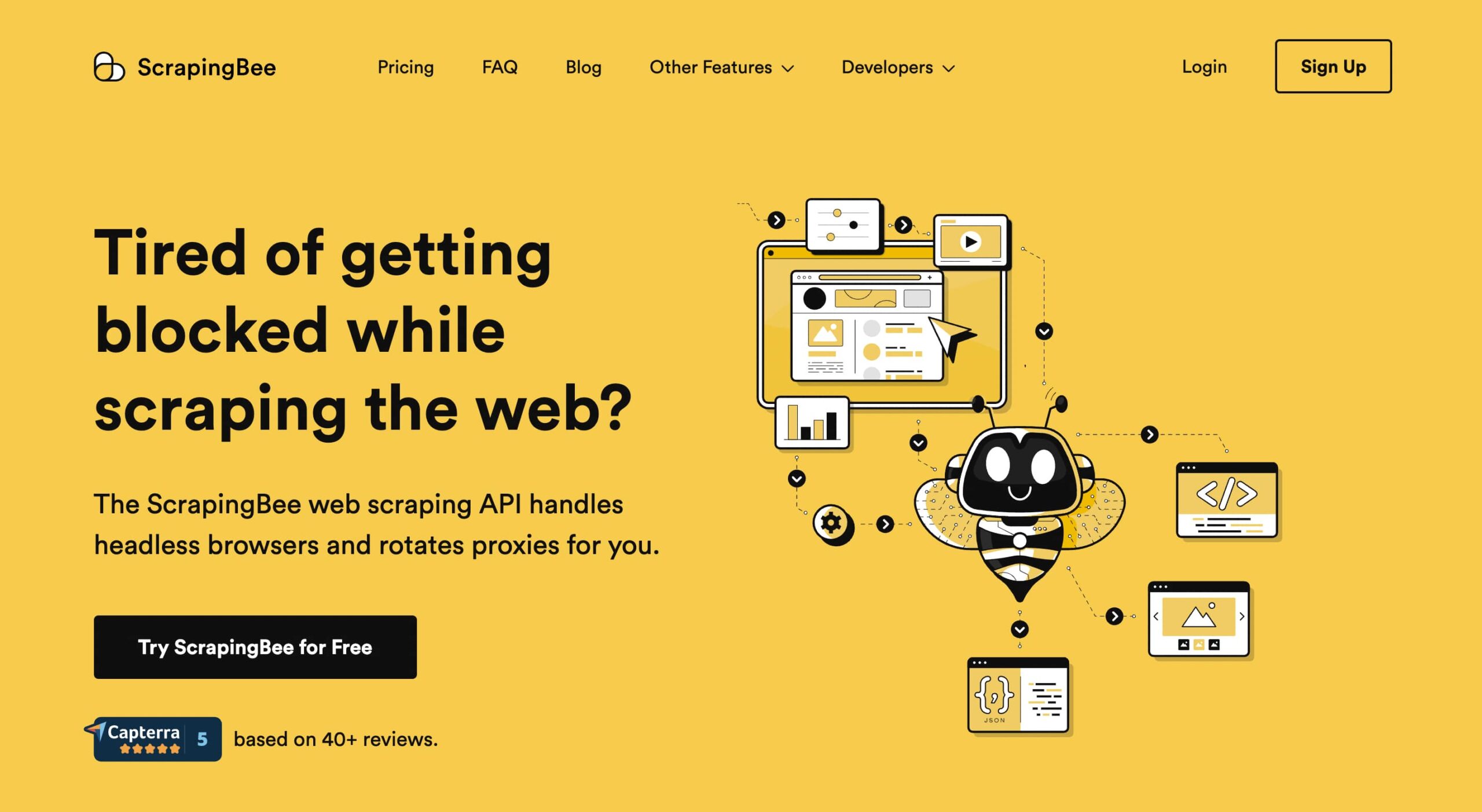
ScrapingBee API is capable of handling headless browsers. Getting blocked while scrapping the web is a common issue that we face. ScrapingBee solves this problem by using rotating proxies. It provides various other awesome features that are explained below.
General Web Scraping: It can do common web scraping tasks like retrieving data from the internet, monitoring prices, and extracting reviews, all without facing blocking issues.
Headless Browsers Handling: You can render web pages like a real browser. This is done with the help of thousands of headless instances using the recent Chrome version.
JavaScript Rendering: This feature allows you to render javascript for scraping any website. Even applications with a single page can be scraped using various libraries like AngularJS, React, etc.
Rotate Proxies: They have a large proxy pool that hides your bots which reduces the chance of getting blocked.
No Code Scarping: Even if you have no coding experience you can use the Make integration feature to build custom web scraping engines.
Screenshots API: This feature allows you to take screenshots of any website with a single API call.
Languages: It supports various programming technologies including Python, JavaScript, Java, Ruby, PHP, and Go.
ScrapingBee Pricing
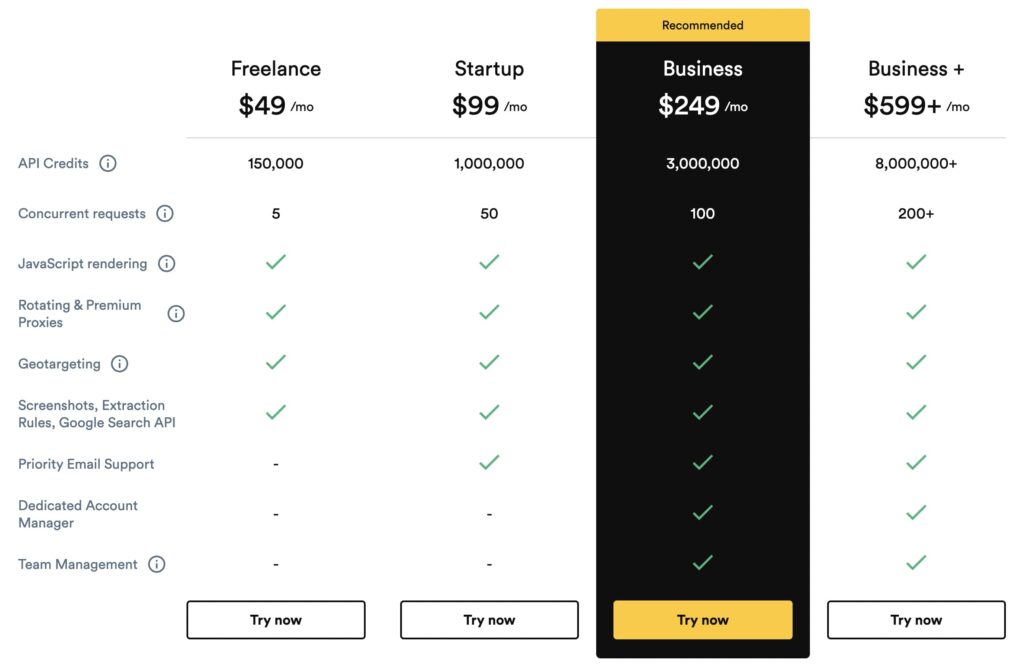
ScrapingBee provides various pricing options that are mentioned below. If you are not sure which plan to use or want to try the service then you can use their free plan that provides 1000 API calls. You are not required to give your credit card details for using free credits.
There are various good things about ScrapingBee that are given below.
Low API response time as compared to other services in the market.
Comes with detailed documentation that is really helpful for beginners.
Provides free API calls for testing the service without giving credit card details.
Supports mindblowing features such as headless browser handling, javascript rendering, rotating proxies, etc.
Bad Things:
ScrapningBee does not have any big issues but still, there are some minor cons that I collected from users reviews on various platforms.
Some of you may find the pricing to be on the higher side.
Some people complained about not being able to scrape some websites.
Even though it provides proxy rotations but still sometimes your scarping bots can be blocked.
Final Words
ScrapingBee API works great for general web scraping, data extraction, and javascript rendering. It is capable of handling headless browsers with the proxy rotation that prevents rate limiting and the chance of getting blocked. With lots of amazing features, this API helps programmers and businesses ability of easy web scraping. ScrapingBee offers flexible pricing plans along with some free API credits to try their service.
In conclusion, I can say it’s one of the best web scraping APIs currently available in the market. Do share in the comment section if you have any queries regarding this API.
A computer is an electronic machine that stores and process data and information and give result in the form of output. It consists of some components which help to manage the storage of data and information and process properly. These components make the working of a computer faster and smoother.
Input devices are hardware devices that are used to enter data and information in the computer system. Users can instruct and give commands to the computer system with the help of input devices. This data or information can be in text form, images, or numbers. It converts them into digital format.
Here are commonly used input devices:
Keyboard: In the computer keyboard is a primary input device. It helps users to communicate with the computer system. By pressing the keys of the keyboard user can type numbers, instructions, etc. Mainly it is used for typing documents, sending emails, and helping to interact with the computer.
Mouse: It controls the cursor on the screen of the computer system or any other electronic device. It is an input device and plays an important role in computer systems. Generally, it is used for choosing options or scrolling pages.
Touchscreen: It allows users to enter commands and information by touching the screen with their fingers. The Touchscreen system is also available in smartphones and tablets. Ex. ATM machine.
Some other input devices are listed below:
Joystick
Light Pen
Track Ball
Scanner
Graphic Tablet
Output Unit
It includes output devices that show results in the form of hardcopy or soft copy after processing the command or instructions. When we give a command through the input unit, the result we get after processing is the output. There are many output devices such as printers, speakers, monitors, etc.
Monitor: The monitor is an output device that is also known as the visual display unit (VDU). It shows a softcopy after processing the commands. It looks like television. It is an essential output device for computer systems.
Printer: The printer is a Hardware computer device. It is an output device that converts softcopy into hardcopy or we can say used to print anything on paper.
Speaker: The speaker is also an output device that is used to listen to sound by connecting to the computer.
There are several other output devices but we have covered only popular ones.
Central Processing Unit
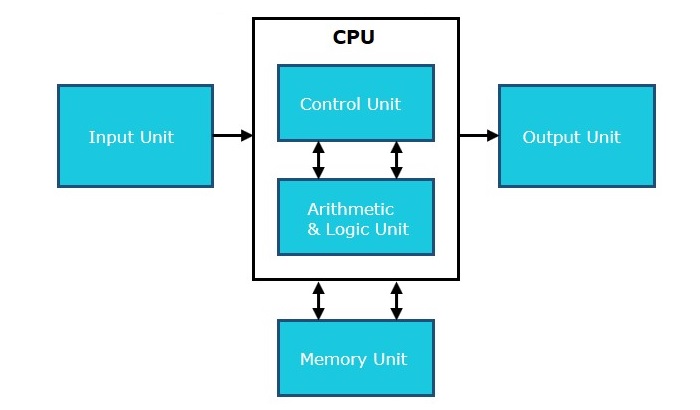
CPU is the brain of a computer that performs all the operations. Its work is to fetch instructions and data from memory and perform operations according to that. CPU consists of mainly three parts that are explained below.
Control Unit
The control unit is one of the main components of the central processing unit. CU directs the operation of the processor. It controls the flow of information. It works by receiving the input instruction after that it converts them into signals and sends them to the processor.
Memory Unit
Memory unit allows the data and information to be stored in the computer system, making it accessible to the software. Generally, it is used for storage work.
Arithmetic and Logical Unit
The arithmetic logic unit is part of the central processing unit that performs arithmetic and logical operations. It can also perform bitwise operations on binary numbers. The arithmetic logic unit consists of two parts, one is AU (arithmetic unit) and the second is LU (Logical unit). ALU can perform addition, subtraction, multiplication, and division. The result of the division operation can be in a floating point unit.
Barbara was born on November 7, 1939, in Los Angeles, California. She has done great work in the field of programming languages. In 2008, she received the prestigious Turing Award in computer science. She is the second woman to receive the Turing Award. The Liskov Substitution Principle, developed by her, states the basic nature of data abstraction and is used in type theory and object-oriented programming.
Bachelor’s degree in Mathematics from the University of California, Berkeley; Ph.D. from Stanford University
Notable Positions
NEC Professor of Software Science and Engineering, Ford Professor of Engineering, MIT Institute Professor
Key Contributions
Liskov Substitution Principle, Venus Operating System
Notable Awards
Discover Magazine’s 50 Most Important Women in Science, IEEE John von Neumann Medal (2004), A.M. Turing Award (2008)
Early Life
Barbara Jane Huberman was born on November 7, 1939, in Los Angeles, California. She comes from a Jewish family. She was the daughter of Jane and Moses Huberman. She was the eldest among her siblings. In 1961, she completed her Mathematics degree at California University, Berkeley. She had only one female classmate in her class at Berkeley. At Berkeley and Princeton, she applied to graduate mathematics programs, but Princeton was not accepting female students in mathematics at that time. As a result, she was accepted at Berkeley. Around the same time, she began working at the Mitre Corporation for one year and later started working as a programming language translator at Harvard.
She decided to return to school and applied to Berkeley, Stanford, and Harvard. She became one of the first women in the US to be awarded a Ph.D. at Stanford University in March 1968. She worked with John McCarthy at Stanford and was involved in artificial intelligence research.
Career
After graduation, she returned to the Mitre Corporation to work as a research staff. She has led many projects, including the Venus operating system. She worked as an NEC Professor of Software Science and Engineering (1986-97), a Ford Professor of Engineering in 1997, and an MIT Institute Professor in 2008. In 2009, she served on the inaugural Engineering and Computer Science jury for the Infosys Prize.
Awards
Discover magazine recognized her as one of the 50 most important women in science. Liskov won the IEEE John von Neumann Medal for fundamental contributions to programming languages in 2004. She received the most prestigious award in computer science, the A.M. Turing Award, in 2008.